

Using Data Analytics to Improve Simulator Revenue
- Boosting Venue Profitability Through Data-Driven Decisions
- Why sports simulation venues must treat data as a revenue asset
- Understanding customer behavior for sports simulation optimization
- Key revenue metrics for sports simulation venues (and how to measure them)
- Example modeled impact: analytics interventions on a sports simulation venue
- Pricing and yield management strategies for sports simulation
- Improving operations and reducing revenue leakage with predictive maintenance
- Marketing and personalization to drive repeat visits for sports simulation
- Tooling and vendor comparison for sports simulation analytics
- Implementation roadmap: turning analytics into consistent revenue
- Case study highlight: how a combined product + analytics approach scales results
- JAMMA Amusement: partner profile and relevance to analytics-driven revenue growth
- How to engage with JAMMA for analytics-ready deployments
- Common pitfalls and how to avoid them in sports simulation analytics projects
- Measuring ROI and next steps
- Frequently Asked Questions (FAQ)
- 1. What types of data are most valuable for increasing sports simulation revenue?
- 2. How quickly can I expect to see revenue improvements after starting an analytics program?
- 3. Do I need a full-time data scientist to benefit from analytics?
- 4. How can predictive maintenance reduce costs for simulator operators?
- 5. What privacy or compliance issues should venues be aware of?
- 6. How does JAMMA support analytics projects for sports simulation venues?
- References
Boosting Venue Profitability Through Data-Driven Decisions
Why sports simulation venues must treat data as a revenue asset
Sports simulation operations—whether golf, baseball, soccer, or multi-sport venues—face tight margins driven by capital equipment costs, staffing, and seasonal demand. Converting data into actionable insights is one of the fastest, lowest-friction ways to increase revenue without large new capital outlays. Data analytics lets operators answer revenue-critical questions: which time slots are underutilized, which customer segments yield the highest lifetime value, what pricing elasticities exist, and how to reduce downtime that leaks revenue. This article lays out practical measurement frameworks, proven tactics, implementation steps, and vendor considerations specific to sports simulation operators.
Understanding customer behavior for sports simulation optimization
Knowing how customers arrive, engage, and convert is foundational. Relevant data sources include booking and reservation logs, POS transactions, loyalty/CRM records, on-device telemetry (session length, mode used, scores), footfall counters, online ad performance, and in-venue survey data. Combine these to build a single customer view (SCV) that links behavior to spend.
Actionable examples:
- Discover that first-time adult users typically book 30–40 minute sessions but buy add-ons 12% of the time; a post-session upsell email increases add-on purchases by 3–5 percentage points.
- Identify that weekend peak hours have waiting lines but low midweek demand—opportunity for off-peak promotions or corporate packages.
Privacy and compliance: ensure customer consent and comply with local regulations (GDPR, CCPA). Anonymize telemetry where required and document data retention policies.
Key revenue metrics for sports simulation venues (and how to measure them)
To convert insights into dollars you must track a concise set of metrics and re-measure after each intervention. Core metrics include:
- Utilization rate = (Booked hours / Available hours) × 100
- Revenue per available hour (RevPAH) = Total revenue / Available hours
- Average transaction value (ATV) and Revenue per user (ARPU)
- Conversion rate (web booking vs. site visits)
- Customer acquisition cost (CAC) and customer lifetime value (CLTV)
- Downtime hours and mean time to repair (MTTR)
Tracking these over time enables causal inference: e.g., if dynamic pricing increases RevPAH while utilization dips slightly, the net revenue effect may still be positive.
Example modeled impact: analytics interventions on a sports simulation venue
Below is a modeled scenario illustrating potential gains from a 6-month analytics program (anonymized outcomes based on multiple operator projects and JAMMA client engagements).
| Metric | Baseline (monthly) | After 6 months (with analytics) | Delta |
|---|---|---|---|
| Utilization | 52% | 64% | +12 pts (23% relative) |
| RevPAH | $45 | $60 | +33% |
| Average transaction value | $18 | $24 | +33% |
| Downtime hours (monthly) | 12 hrs | 4 hrs | -67% |
| Monthly revenue | $35,000 | $48,000 | +37% |
Notes: this model blends higher utilization (via yield management and targeted promotions), higher ATV (via segmentation and upsells), and reduced downtime (via predictive maintenance). Individual results vary; operators should run pilots and measure uplift relative to controls.
Pricing and yield management strategies for sports simulation
Pricing is not one-size-fits-all. Data enables dynamic strategies that respect customer psychology and preserve perceived value:
- Time-based pricing: higher rates for prime hours; discounts for weekday or off-peak slots.
- Package bundling: multi-session passes, family bundles, or skill-development packages.
- Memberships and subscriptions: increase recurring revenue and improve CLTV; use analytics to identify the optimal price and benefit mix.
- Promotional targeting: use look-back windows to target customers who booked once and didn’t return.
Analytics helps quantify price elasticity by segment: some groups are price-sensitive (students, casual players), others value convenience or prestige (corporate groups, private coaching) and can pay High Qualitys.
Improving operations and reducing revenue leakage with predictive maintenance
Hardware downtime directly reduces capacity and customer satisfaction. Deploying sensors and device telemetry to support predictive maintenance reduces unscheduled downtime and repair costs. Typical predictive maintenance benefits include:
- Lower mean time to detection (sensors flag anomalies before failure).
- Planned maintenance windows scheduled during low-revenue periods.
- Reduced spare parts inventory via more accurate failure forecasts.
Case example: replacing a reactive repair program with a condition-based program can reduce downtime by 50–70% (results vary by equipment and maturity). Implement predictive maintenance by instrumenting key components, aggregating logs, training failure models, and integrating alerts into operations scheduling.
Marketing and personalization to drive repeat visits for sports simulation
Many operators waste ad spend by targeting broadly. Data segmentation allows personalized offers that convert at higher rates and cost less per acquisition:
- Segment by behavior: high-scorers who enjoy competition vs. families who seek entertainment.
- Triggered communications: abandoned booking reminders, post-visit offers, milestone rewards.
- Audience lookalikes: use high-value customer profiles to inform ad targeting on platforms like Facebook and Google.
Measure paid acquisition efficiency using CAC / CLTV. Prioritize acquisition channels that show favorable return on ad spend (ROAS) for high-value segments and reduce spend on low ROAS campaigns.
Tooling and vendor comparison for sports simulation analytics
Operators need tools that integrate device telemetry, bookings, POS, and marketing platforms. Below is a concise comparison of tool categories and representative vendors.
| Category | Purpose | Representative vendors | Notes |
|---|---|---|---|
| BI & dashboards | Aggregate KPIs, visualize trends | Tableau, Power BI, Looker | Essential for executive and ops visibility |
| CRM & email automation | Segment customers, automate communications | HubSpot, Klaviyo, Salesforce | Integrate booking and POS data for SCV |
| Booking & POS | Reservations, payments, inventory | Mindbody, OpenTable-like vendors, bespoke POS | Choose systems with API access |
| Telemetry & IoT platforms | Capture machine data and alerts | AWS IoT, Azure IoT, vendor SDKs | Needed for predictive maintenance |
Implementation roadmap: turning analytics into consistent revenue
Recommended phased approach:
- Audit (0–2 weeks): inventory systems, data sources, and permissions.
- Define KPIs (1–2 weeks): pick the 5 core metrics and baseline them.
- Data pipeline (4–8 weeks): connect booking, POS, device logs to a BI/warehouse.
- Pilot (8–12 weeks): run A/B tests for pricing, targeted emails, or predictive maintenance on a subset of simulators or days.
- Scale (3–6 months): roll out successful tactics, automate dashboards, refine models.
- Governance (ongoing): data quality checks, privacy reviews, and periodic model retraining.
Staffing: small venues can outsource analytics vs. building an in-house data scientist. Typical first-year analytics investments range broadly—often from $10k–$60k depending on scope—with payback frequently in under a year when initiatives focus on pricing, utilization, and downtime reduction.
Case study highlight: how a combined product + analytics approach scales results
Effective analytics is frequently paired with modern, flexible hardware and vendor support. JAMMA Amusement has worked with venues to combine equipment capability with analytics programs to accelerate outcomes. The vendor capabilities that matter include API access to session logs, robust telemetry, and a responsive technical team that can deliver firmware updates and telemetry endpoints.
JAMMA Amusement: partner profile and relevance to analytics-driven revenue growth
JAMMA Amusement was established in 2009, located in Guangzhou, with 15 years of experience in the amusement industry. Focusing on providing high-value, one-stop solutions for amusement projects, our products include VR games, AR sports simulators, AR interactive projection games, 5D cinema, as well as arcade games and outdoor playground equipment. We have a highly efficient international sales team dedicated to understanding customer needs and providing professional solutions and high-quality products for venues. Our industry-leading technical team keeps abreast of the latest technological trends and continuously develops and updates the products. Our manufacturing and after-sales teams are skilled and experienced, providing comprehensive technical support. We are committed to becoming a leading global provider of amusement equipment and park solutions. Our website is https://www.jammapark.com/.
JAMMA's advantages for operators pursuing analytics-driven revenue improvement:
- Integrated telemetry-ready sports simulators that provide session and hardware logs needed for utilization and predictive maintenance models.
- Customizable software layers that expose booking and session APIs to BI and CRM platforms.
- Comprehensive product mix—Sports Simulators, Interactive Projection Games, Immersive Attractions, VR Games—allowing operators to bundle experiences and track cross-product performance data.
- Experienced international sales and technical teams that support rapid pilots and iterative deployments.
For venues seeking a partner able to provide both hardware and a pathway to analytics-driven operations, JAMMA offers tangible advantages: robust product telemetry, global support, and experience implementing venue-level solutions that prioritize uptime and customer experience.
How to engage with JAMMA for analytics-ready deployments
Operators can accelerate revenue improvements by choosing equipment and vendors who commit to telemetry access and integration support. Key questions to ask JAMMA or any vendor before purchase:
- Does the simulator provide session-level logs via API or export?
- Can the device send real-time alerts for component faults?
- Is there documented data schema and support for integrating with common BI/CRM tools?
Contact JAMMA via https://www.jammapark.com/ to discuss available sports simulation products and integration options. JAMMA’s product portfolio and support services can shorten the time to revenue uplift by enabling immediate access to the underlying data stream.
Common pitfalls and how to avoid them in sports simulation analytics projects
Beware of these frequently encountered issues:
- Poor data quality: reconcile time zones, booking cancellations, and partial-session refunds early.
- Overfitting: don’t trust a model trained on a single busy weekend—validate across months.
- Ignoring operations: analytics that aren’t operationalized—i.e., linked to scheduling or pricing systems—won’t move the needle.
- Under-investing in change management: staff adoption (reception, floor managers) matters more than the sophistication of algorithms.
Measuring ROI and next steps
ROI example: if analytics plus operational changes increase monthly revenue by $13,000 (model earlier) and the first-year analytics investment is $24,000, payback occurs in under two months in that scenario. Use a simple ROI framework: incremental monthly revenue × months in period – investment = net benefit. Track leading indicators (utilization, conversion) to predict revenue uplift before full financial results arrive.
Frequently Asked Questions (FAQ)
1. What types of data are most valuable for increasing sports simulation revenue?
Booking/reservation logs, POS transactions, session telemetry (duration, mode, scores), attendance/footfall, and customer CRM data are most valuable. Combined, they provide the single customer view needed for segmentation, pricing, and retention tactics.
2. How quickly can I expect to see revenue improvements after starting an analytics program?
Many operators see measurable improvements within 2–3 months from focused pilots (pricing experiments, targeted marketing, or predictive maintenance). Larger structural changes (membership models) typically take longer—3–9 months—to fully realize.
3. Do I need a full-time data scientist to benefit from analytics?
No. Small-to-medium operators can outsource initial analytics work to vendors or consultants and use pre-built dashboards and integrations. As analytics matures, bringing some capability in-house can accelerate custom work.
4. How can predictive maintenance reduce costs for simulator operators?
Predictive maintenance identifies component degradation early, enabling planned repairs during low-demand periods, reducing emergency repairs, and minimizing lost revenue due to downtime. Typical downtime reductions range from 30% to 70% depending on maturity.
5. What privacy or compliance issues should venues be aware of?
Collect only necessary personal data, obtain consent for marketing communications, and comply with applicable laws (GDPR in EU, CCPA in California). Anonymize telemetry as appropriate and maintain a clear data retention policy.
6. How does JAMMA support analytics projects for sports simulation venues?
JAMMA provides telemetry-ready sports simulators, documented APIs, and international support to help venues access session and hardware data. Their products and teams can assist with integration plans that accelerate analytics pilots and scale deployments.
Ready to increase your simulator revenue? Contact JAMMA Amusement to discuss analytics-ready sports simulation solutions and deployment options: https://www.jammapark.com/
References
- McKinsey & Company, The age of analytics: Competing in a data-driven world, 2016. https://www.mckinsey.com/business-functions/mckinsey-analytics/our-insights/the-age-of-analytics-competing-in-a-data-driven-world (accessed 2025-11-01)
- Deloitte Insights, Predictive maintenance: How to reduce downtime and improve reliability, Deloitte, 2020. https://www2.deloitte.com/global/en/pages/operations/articles/predictive-maintenance. (accessed 2025-11-01)
- ICO, Guide to Data Protection (GDPR guidance), Information Commissioner's Office (UK). https://ico.org.uk/for-organisations/guide-to-data-protection/ (accessed 2025-11-01)
- HubSpot, Marketing Statistics and Benchmarks. https://www.hubspot.com/marketing-statistics (accessed 2025-11-01)
- JAMMA Amusement official site, company and product pages. https://www.jammapark.com/ (accessed 2025-11-01)
How to start a tennis simulator machine business in Europe
ROI Analysis: Multi-sport Simulator for Amusement Businesses
Why choose JAMMA as your golf simulator sale supplier in Europe
VR vs Mechanical Football Simulators: Which Is Better?
Standard and other
Are you an amusement park equipment manufacturer?
Yes. We have our own production factory, which is located in Guangzhou, China, covering an area of over 2,000 square meters. With our professional production team, we are able to ensure high quality and on-time delivery of our products. All products have undergone rigorous testing and quality inspection. You are welcome to visit our factory.
Do you offer a customized service?
We can provide logo customization service for all of our products. For certain products, we can also support customization of sizes and game content. If you have any product customization requirements, please contact us and we will confirm the details with you.
Product details
Can I customize the number of seats of 5D cinema?
Yes, we generally have options for six, nine, eighteen, twenty-four, and thirty-six seats, and the quantity of seats also can be customized.
What is the difference between 5D and 3D?
The visual of 5D cinema is the same as that of 3D, compared to 3D, it adds motion simulation and special effects, which are not available in 3D.
Does the soccer simulator configuration include the curtain?
Yes, a 4-meter-wide, 3-meter-high projection curtain is included.
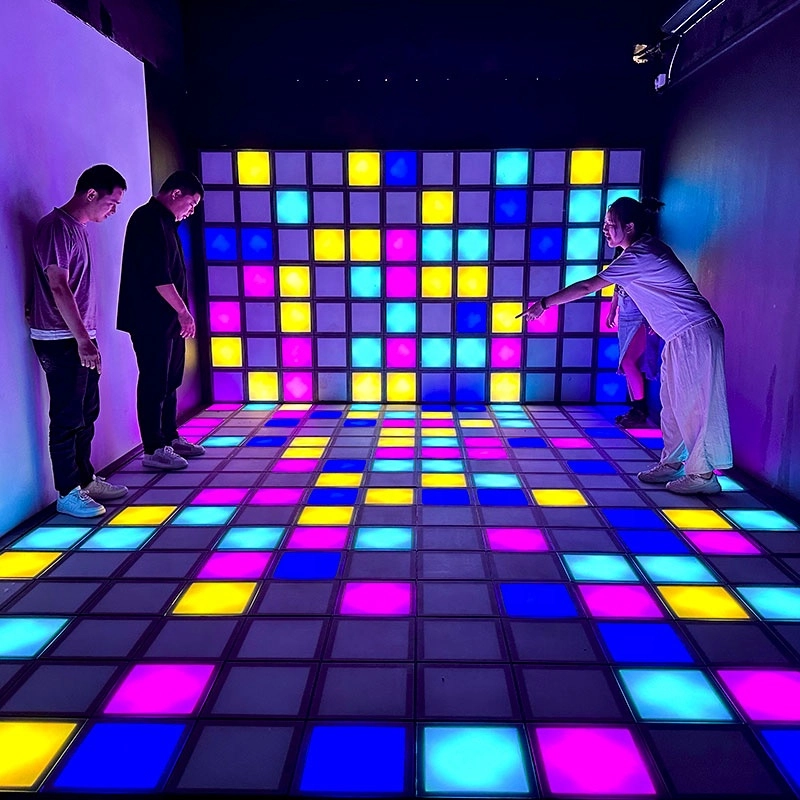
Hottest activated LED dance grid tiles floor touch games
Super Grid is an immersive sports game that combines sports and technology. It integrates interactive LED lights and sensors through innovative software design, creating a fun gaming experience.
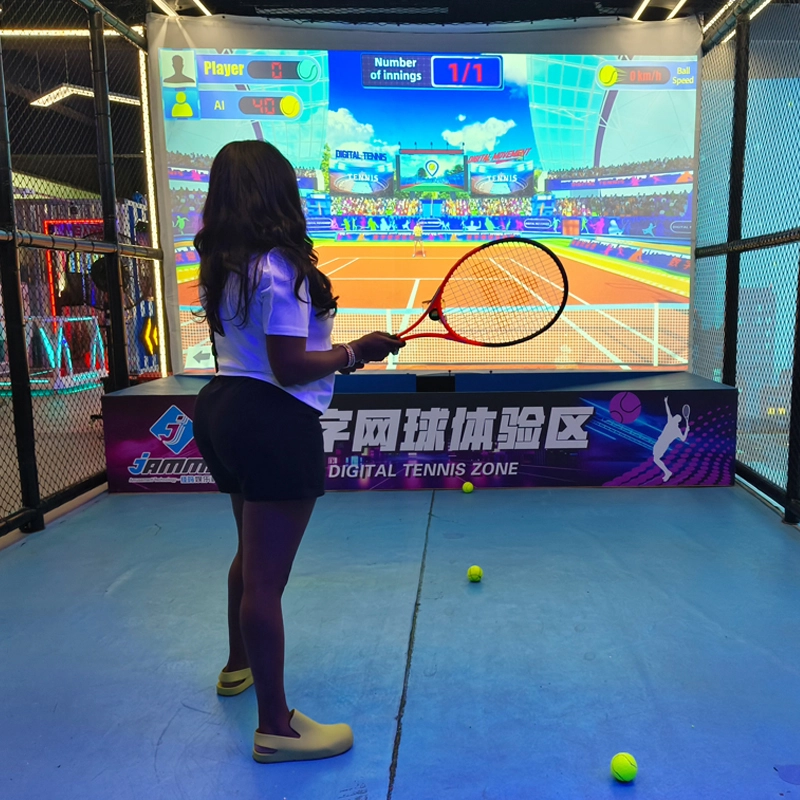
Top Indoor Tennis Racketball Training Simulator Dual Player Games
Interactive somatosensory fitness game
Combine traditional tennis sports with advanced 3D digital technology to bring customers an immersive tennis training experience
COMBINE TRADITIONAL TENNIS SPORTS WITH ADVANCED 3D DIGITAL TECHNOLOGY TO BRING CUSTOMERS AN IMMERSIVE TENNIS TRAINING EXPERIENCE INDOOR AND TENNIS EXPERIENCE HALL
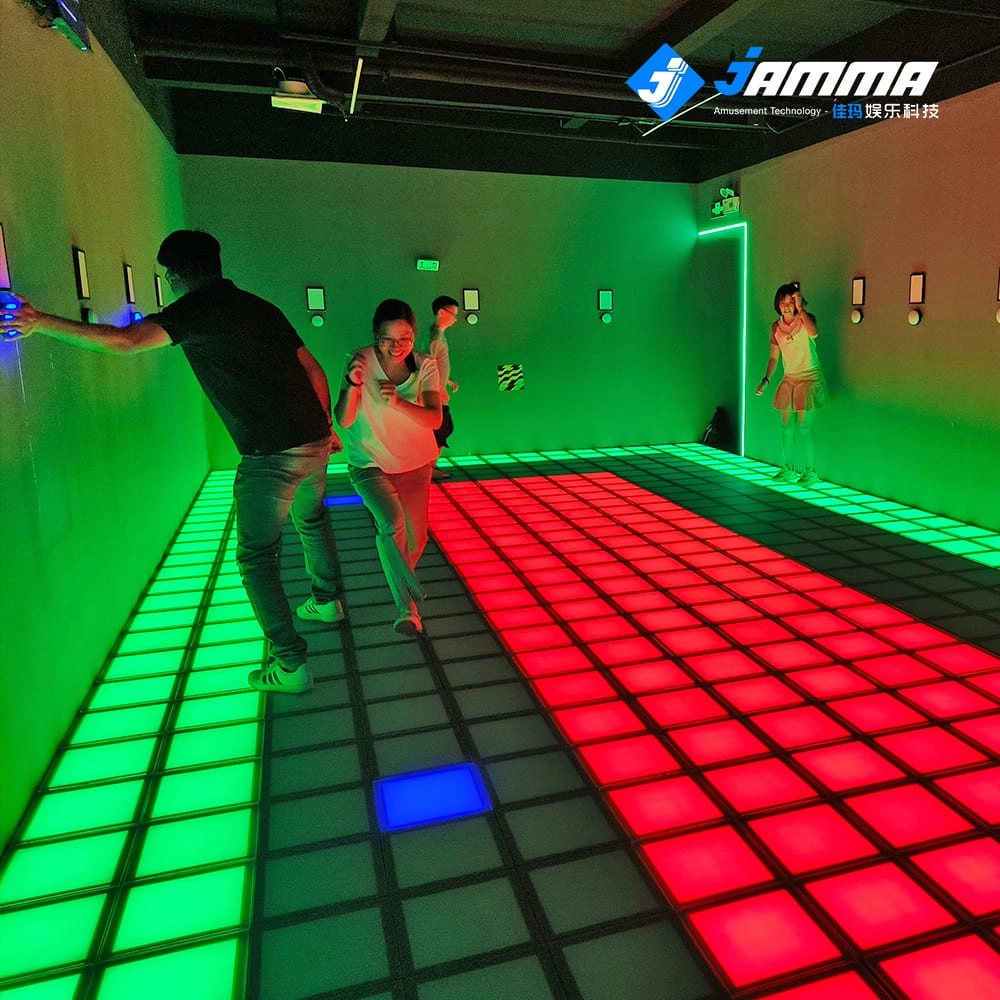
Super Grid Interactive LED Floor Activate Game Team Play
Super Grid is an immersive sports game that combines sports and technology. It integrates interactive LED lights and sensors through innovative software design, creating a fun gaming experience.
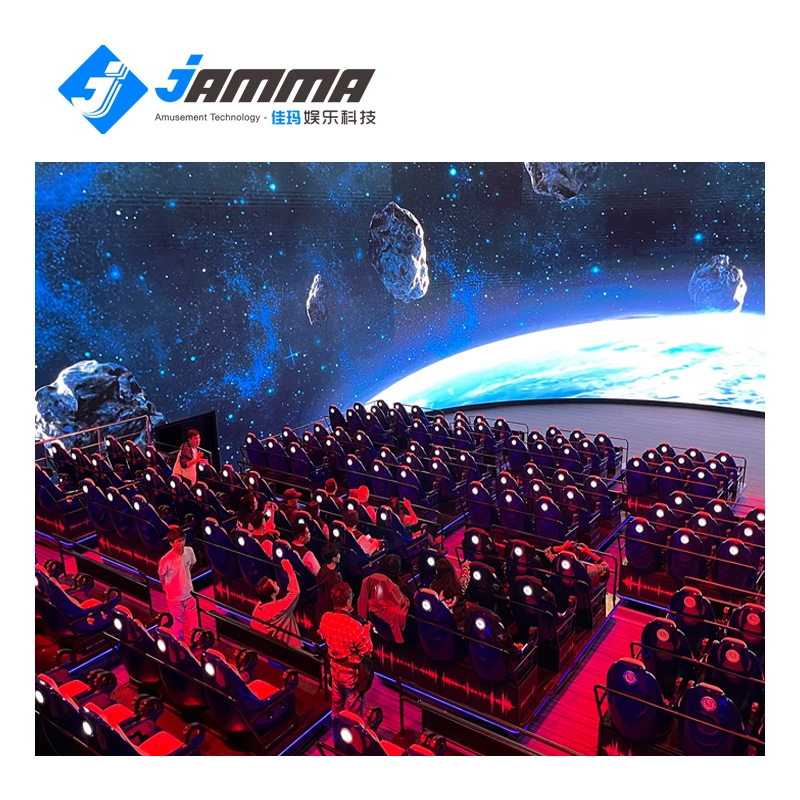
Immersive 5D/7D/9D cinema dynamic visual experience room
Compared with other types of theaters, 5D/7D/9D cinema have high technical content, prominent themes, and have a strong impact on the characteristics of the picture. With the increasing demand in the entertainment market and the continuous development of video entertainment technology, in the past, audiences would experience vibration, drop, rain, scratches and other effects in some 4D theaters, but now with 5D theaters, audiences can experience new Unique features, touch and feel effects such asreal smoke, water, snow, bubbles, smell, lightning, leg touch,camera system and more. When the audience is watching amovie, the seats and environmental effects will change into corresponding actions according to the development of the movie,allowing the audience to experience an immersive viewing experience.
