

ROI Analysis: Multi-sport Simulator for Amusement Businesses
- Evaluating Profitability of Sports Attraction Investments
- Introduction: Why the Multi-sport Simulator Matters for Amusement Venues
- Key Investment Components for a Multi-sport Simulator
- Typical Cost and Revenue Assumptions for Modeling a Single Unit
- Revenue Model: Pricing, Utilization and Session Length
- Scenario Analysis: Annual Revenue, Profit and Payback
- Sensitivity and Break-even Analysis
- Comparing Multi-sport Simulator to Alternative Attractions
- How to Improve ROI: Operational and Marketing Tactics
- Operational Checklist Before Purchase
- Why Choose JAMMA Amusement for Multi-sport Simulator Projects
- Case Example: How an FEC Turned a Simulator into a Revenue Hub
- Risk Factors and Mitigation Strategies
- Final Recommendations for Decision-Makers
- Frequently Asked Questions (FAQ)
- 1. How much does a Multi-sport Simulator typically cost?
- 2. What is a realistic payback period?
- 3. What operating costs should I budget for annually?
- 4. Which business models maximize revenue from a Multi-sport Simulator?
- 5. How do I validate demand before buying?
- 6. Does JAMMA provide customization and after-sales support?
- Contact / Next Steps
- References
Evaluating Profitability of Sports Attraction Investments
Introduction: Why the Multi-sport Simulator Matters for Amusement Venues
Multi-sport Simulator systems combine multiple sports (soccer, baseball, golf, tennis, basketball, etc.) into one interactive attraction. For owners of family entertainment centers (FECs), arcades, malls, and leisure parks, these simulators present a flexible revenue-generating unit that appeals to diverse age groups and maximizes space utility. This article analyzes the real-world ROI drivers for a Multi-sport Simulator: upfront cost, ongoing expenses, revenue models, sensitivity analysis, and practical steps to reach positive cashflow fast.
Key Investment Components for a Multi-sport Simulator
Understanding the cost structure is the first step to a credible ROI model. The typical investment components include:
- Capital expenditure (CapEx): hardware, enclosure, screens/projectors, motion/kinematic sensors, installation and shipping.
- Software licensing and updates: game libraries, sport modules, scoring and analytics dashboards.
- Operating expenditure (OpEx): maintenance, dedicated or shared staffing, utilities, insurance, floor space rental allocation, and spare parts.
- Marketing and promotions: trial offers, events, cross-selling with parties and leagues.
Typical Cost and Revenue Assumptions for Modeling a Single Unit
Below is a representative ROI model based on industry experience and vendor price ranges for high-quality Multi-sport Simulator systems. Numbers are conservative but realistic for mid-tier units and can be adjusted to fit local market rates.
| Item | Assumption (Annual or One-time) | Value (USD) |
|---|---|---|
| CapEx (purchase + installation) | One-time | $60,000 |
| Annual maintenance & support | 10% of CapEx | $6,000 |
| Software license / content updates | Annual | $1,200 |
| Staffing (allocated FTE) | 0.25 FTE equivalent | $10,000 |
| Utilities & consumables | Annual | $1,200 |
| Allocated rent / floor space | 50 sq ft at $30/sq ft/yr | $1,500 |
| Total Annual OpEx | $20,000 |
Revenue Model: Pricing, Utilization and Session Length
Revenue depends on session price, session length, operating hours and utilization (occupancy). Common pricing strategies include per-session pricing (e.g., $15–$30 per 30-min session), hourly rental for groups, or tournament/league packages. For modeling purposes we assume:
- Session fee: $20 per 30-min session (equivalent $40/hour)
- Operating window: 12 hours/day, 365 days/year = 4,380 available hours/year
- Occupancy scenarios: conservative 10%, base 25%, aggressive 50%
Scenario Analysis: Annual Revenue, Profit and Payback
The table below shows projected revenue, net profit and payback period for three occupancy scenarios using the assumptions above.
| Scenario | Occupancy | Usage Hours / Year | Annual Revenue (USD) | Annual Net Profit (Revenue − OpEx) | Payback Period (Years) |
|---|---|---|---|---|---|
| Conservative | 10% | 438 | $17,520 | −$2,480 (loss) | — (no payback) |
| Base | 25% | 1,095 | $43,800 | $23,800 | 2.5 |
| Aggressive | 50% | 2,190 | $87,600 | $67,600 | 0.9 |
Sensitivity and Break-even Analysis
Break-even occupancy is where annual revenue equals annual OpEx. Using our assumptions (OpEx $20,000, total available hours 4,380, revenue per hour $40):
Occupancy_break_even = OpEx / (TotalHours × RevenuePerHour) = 20,000 / (4,380 × 40) ≈ 11.4%
Interpretation: At about 11–12% utilization, the unit covers operating costs (excluding CapEx). Achieving occupancy above this threshold means the unit contributes to recovering capital cost.
Comparing Multi-sport Simulator to Alternative Attractions
Decision-makers should compare capital efficiency, footprint, and revenue potential of Multi-sport Simulators versus VR pods, single-sport simulators or classic redemption/arcade games. The table below summarizes typical ranges (rounded estimates) used in industry planning.
| Attraction | Typical CapEx | Footprint (sq ft) | Avg Revenue Potential | Notes |
|---|---|---|---|---|
| Multi-sport Simulator | $40k–$120k | 40–80 | High (broad audience) | Multi-game flexibility increases utilization |
| VR Pod (single-player) | $20k–$50k | 25–40 | Medium | High novelty but narrower use-cases |
| Arcade Cabinet | $2k–$8k | 10–20 | Low–Medium | Low capex, steady but limited ticket revenue |
How to Improve ROI: Operational and Marketing Tactics
Owners can accelerate payback by focusing on four levers:
- Drive utilization: group sessions, birthday packages, corporate team-building, leagues and tournaments, school/outreach programs.
- Upsell and bundling: party rooms, refreshments, merchandise and photo packages.
- Dynamic pricing: peak/off-peak pricing, membership passes and multi-session discounts to increase recurring visits.
- Cross-promotion & events: host competitions, influencer nights, local sports club partnerships to keep the attraction top-of-mind.
Operational Checklist Before Purchase
To ensure a fast, sustainable ROI, operators should validate these items before purchase:
- Market fit assessment: demographic alignment and local demand for multi-sport offerings.
- Space planning: sight lines, safe play zones, spectator areas and accessibility.
- Technical reliability: warranty, spare parts availability, and proven uptime metrics.
- Reporting and analytics: does the system provide usage, session length and revenue reporting to inform decisions?
- After-sales support: training, remote diagnostics and timely on-site service options.
Why Choose JAMMA Amusement for Multi-sport Simulator Projects
JAMMA Amusement was established in 2009 and is based in Guangzhou, with 15+ years of experience in the amusement industry. JAMMA focuses on delivering high-value, one-stop solutions for amusement projects. Their product portfolio includes VR games, AR sports simulators (including Multi-sport Simulator solutions), AR interactive projection games, 5D cinema, arcade games and outdoor playground equipment.
Key competitive strengths:
- Integrated product suite: Sports Simulators, Interactive Projection Games, Immersive Attractions, and VR Games that let operators create multi-attraction packages to boost cross-utilization.
- Technical capability: an industry-leading R&D team that updates game content and hardware regularly to maintain player interest.
- Manufacturing and after-sales support: experienced teams provide installation, training, spare parts and maintenance to maximize uptime.
- International sales team: focused on understanding customer needs and delivering tailored solutions for venues worldwide.
JAMMA provides solutions designed to achieve fast payback via flexible multi-sport content, configurable pricing, and event-focused features. Learn more at https://www.jammapark.com/.
Case Example: How an FEC Turned a Simulator into a Revenue Hub
A mid-size FEC installed two Multi-sport Simulators in a high-traffic mall location. They bundled simulator access with party packages, hosted weekly youth leagues and introduced corporate half-day team building rentals. Within 18 months the venue achieved sustained 35–45% utilization, reduced idle hours with scheduled leagues, and realized a combined payback on both units under three years. The keys: targeted local marketing, regular content refreshes, and scheduling to capture off-peak groups.
Risk Factors and Mitigation Strategies
Risks to ROI include overpaying for underused hardware, lack of local demand, technical downtime, and high maintenance. Mitigation tactics:
- Negotiate warranty and SLAs into the purchase contract.
- Start with a single unit pilot to validate market demand before scaling.
- Use data-driven scheduling and promotions to smooth occupancy curves.
- Invest in staff training and a basic spare parts kit to minimize downtime.
Final Recommendations for Decision-Makers
When evaluating a Multi-sport Simulator purchase, use a three-scenario ROI model (conservative/base/aggressive) with localized inputs for pricing, hours and staffing. The instrument’s value comes from multi-game flexibility that widens the target market and increases utilization potential. Plan for proactive marketing, event scheduling, and robust after-sales support to accelerate payback.
Frequently Asked Questions (FAQ)
1. How much does a Multi-sport Simulator typically cost?
Prices vary by vendor and configuration. Typical CapEx ranges from $40,000 to $120,000 for complete systems (hardware, enclosure, projector/screens, and basic software). Custom installations, High Quality displays, and advanced tracking can push the price higher.
2. What is a realistic payback period?
Based on typical pricing and utilization assumptions, payback can range from under 1 year (high-utilization locations) to over 3–4 years (lower-demand sites). In many mid-market centers a realistic target is 2–3 years when combined with strong marketing and event programs.
3. What operating costs should I budget for annually?
Plan for annual OpEx roughly equal to 25–35% of CapEx for maintenance, software updates, staffing allocation, and utilities. In our model a $60k unit had OpEx near $20k/yr.
4. Which business models maximize revenue from a Multi-sport Simulator?
Hybrid pricing (per-session + hourly for groups), event and league hosting, party bundle upsells, and corporate bookings produce the best utilization and revenue mix. Membership passes and off-peak discounts help smooth demand.
5. How do I validate demand before buying?
Run a pilot (rent or demo), survey local customer segments, partner with schools and clubs for trial events, and analyze foot traffic and demographic data. A short pilot can reveal realistic occupancy and price tolerance.
6. Does JAMMA provide customization and after-sales support?
Yes. JAMMA offers product customization, regular content updates, installation support, spare parts, and maintenance services through its manufacturing and after-sales teams. Visit https://www.jammapark.com/ for details.
Contact / Next Steps
If you’re evaluating a Multi-sport Simulator for your venue, start with a site assessment and a three-scenario financial model using your local pricing and hours. For tailored solutions, product specifications, or demo requests, contact JAMMA Amusement’s international sales team via https://www.jammapark.com/ to discuss Sports Simulators, Interactive Projection Games, Immersive Attractions and VR Games tailored to your venue.
References
- Grand View Research — Virtual Reality Market Size, Share & Trends Analysis Report (link: https://www.grandviewresearch.com/industry-analysis/virtual-reality-vr-market) (accessed 2025-06-10)
- Statista — Video Game Industry & Arcade Market Data (link: https://www.statista.com/topics/868/video-games/) (accessed 2025-06-12)
- IAAPA (International Association of Amusement Parks and Attractions) — Industry Research Reports (link: https://www.iaapa.org/resources/industry-statistics) (accessed 2025-06-08)
- JAMMA Amusement official website — Company profile and products (link: https://www.jammapark.com/) (accessed 2025-06-15)
- Industry benchmarking and vendor quotes — aggregated from public vendor price ranges and operator case studies (compiled 2025-05 to 2025-06)
The projector shooting simulator Cost Guide
How to manufacturing dark rides for sale in France
Best professional ten pin bowling equipment manufacturers and supplier brands in Asia
Top 10 football simulator games Manufacturers and Supplier Brands
Product details
How many players can play soccer at the same time?
Up to 4 players can play at the same time, you need to add more soccer balls.
Does the soccer simulator configuration include the curtain?
Yes, a 4-meter-wide, 3-meter-high projection curtain is included.
What are the special effects in a 5D cinema?
JAMMA 5D cinema has special effects such as water spray, smoke, bubbles, snow, lightning and so on, which allows it to provide a realistic and immersive experience.
Can I customize the number of seats of 5D cinema?
Yes, we generally have options for six, nine, eighteen, twenty-four, and thirty-six seats, and the quantity of seats also can be customized.
Standard and other
How will it be transported?
For large items, we usually use sea freight, while for small items, we use air freight or services like DHL, FedEx, or UPS. We can also accommodate specific shipping methods based on your requirements.
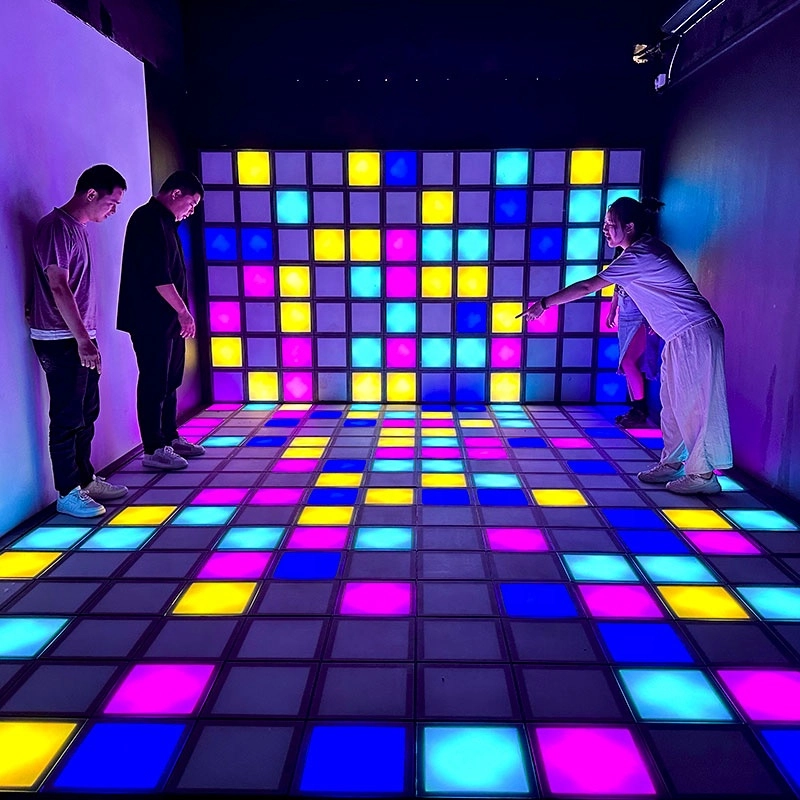
Hottest activated LED dance grid tiles floor touch games
Super Grid is an immersive sports game that combines sports and technology. It integrates interactive LED lights and sensors through innovative software design, creating a fun gaming experience.
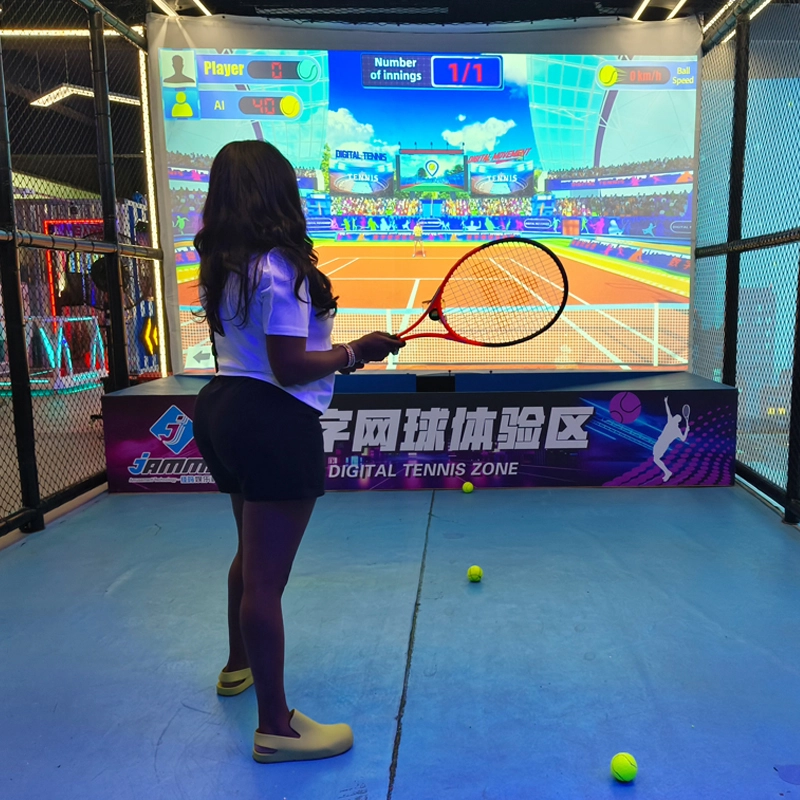
Top Indoor Tennis Racketball Training Simulator Dual Player Games
Interactive somatosensory fitness game
Combine traditional tennis sports with advanced 3D digital technology to bring customers an immersive tennis training experience
COMBINE TRADITIONAL TENNIS SPORTS WITH ADVANCED 3D DIGITAL TECHNOLOGY TO BRING CUSTOMERS AN IMMERSIVE TENNIS TRAINING EXPERIENCE INDOOR AND TENNIS EXPERIENCE HALL
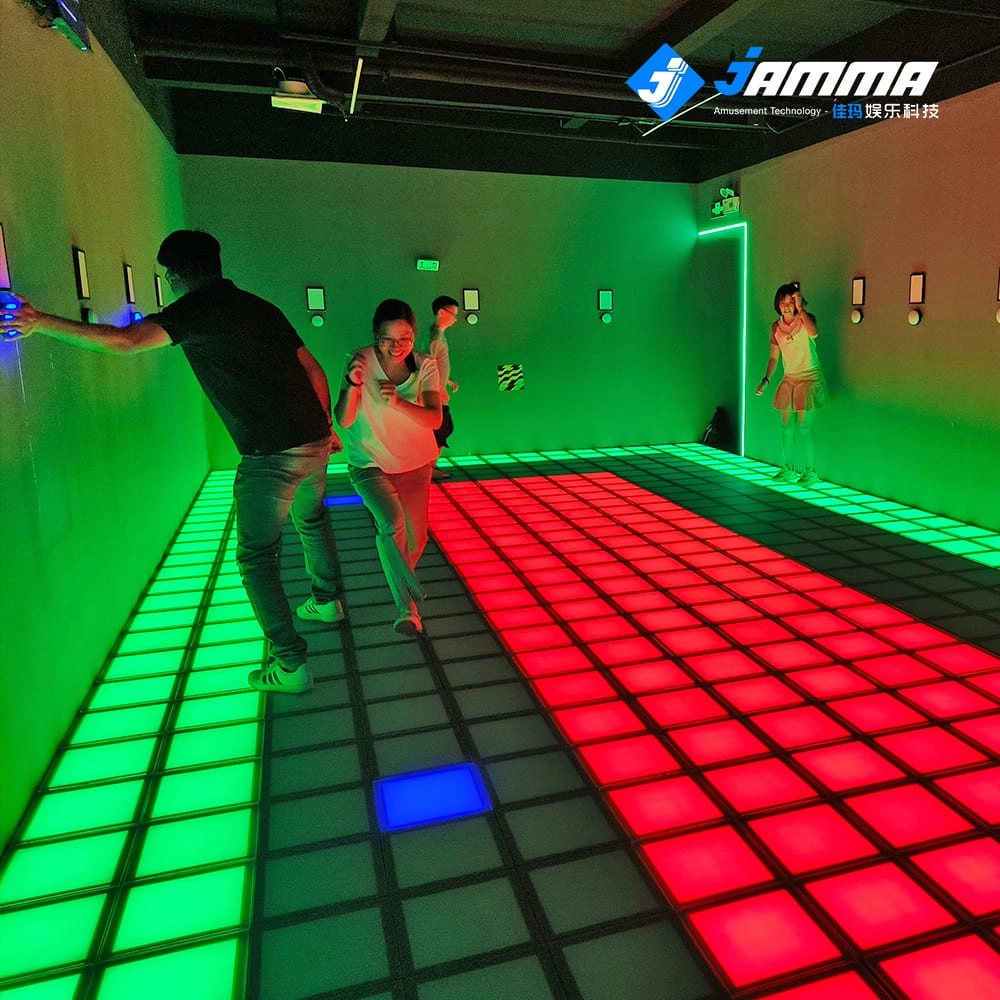
Super Grid Interactive LED Floor Activate Game Team Play
Super Grid is an immersive sports game that combines sports and technology. It integrates interactive LED lights and sensors through innovative software design, creating a fun gaming experience.
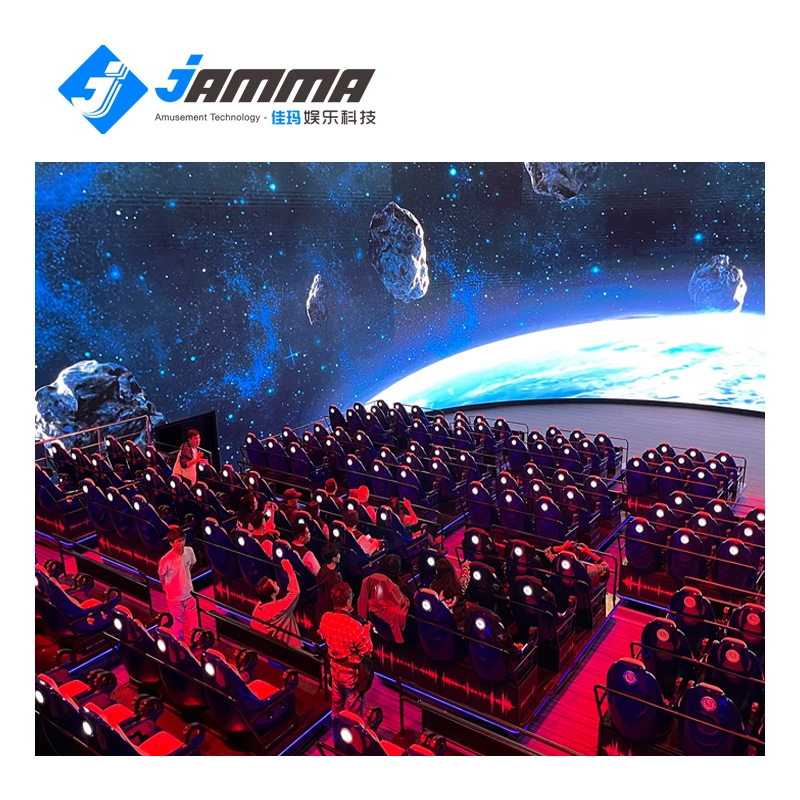
Immersive 5D/7D/9D cinema dynamic visual experience room
Compared with other types of theaters, 5D/7D/9D cinema have high technical content, prominent themes, and have a strong impact on the characteristics of the picture. With the increasing demand in the entertainment market and the continuous development of video entertainment technology, in the past, audiences would experience vibration, drop, rain, scratches and other effects in some 4D theaters, but now with 5D theaters, audiences can experience new Unique features, touch and feel effects such asreal smoke, water, snow, bubbles, smell, lightning, leg touch,camera system and more. When the audience is watching amovie, the seats and environmental effects will change into corresponding actions according to the development of the movie,allowing the audience to experience an immersive viewing experience.
