

Integrating VR with Multi-sport Simulators in Arcades
- Why Arcades Need Immersive Sports Technology
- Understanding Multi-sport Simulator Value in Arcades
- Key Use Cases for Multi-sport Simulator + VR
- Hardware and Physical Integration Requirements for VR Multi-sport Simulator
- Space Planning and Safety
- Software, Content and User Experience Considerations
- Content Strategy for Repeat Visits
- Technical Integration: Latency, Tracking and Calibration
- Operations, Throughput and Pricing Models
- Pricing and Session Design
- ROI and Business Metrics — Practical Estimates
- Maintenance, Safety and Lifecycle Management
- Sanitation and Health Protocols
- Comparing VR Integration Options for Multi-sport Simulator
- Selecting Vendors and Content Partners
- Case Study: Typical Implementation Timeline
- JAMMA Amusement: Partnering for Multi-sport Simulator and VR Integration
- Why Choose JAMMA for Multi-sport Simulator + VR Projects
- Checklist Before You Buy: Evaluating a Multi-sport Simulator with VR
- Frequently Asked Questions (FAQ)
- 1. What is a Multi-sport Simulator and how does VR change it?
- 2. How much floor space is required for a VR-enabled Multi-sport Simulator?
- 3. What are typical pricing models for guest sessions?
- 4. How do I manage hygiene and headset maintenance?
- 5. Can VR Multi-sport Simulators integrate with my existing arcade management system?
- 6. What's the expected payback period?
- Contact and Next Steps
- References
Why Arcades Need Immersive Sports Technology
Arcades are no longer just rows of redemption machines and racing cabinets. Today’s operators compete for attention against home consoles, mobile gaming and streaming entertainment. Integrating Virtual Reality (VR) with a Multi-sport Simulator creates a differentiated destination experience that drives dwell time, increases per-player spend and attracts new demographics. This article provides a practical guide to implementing VR-enabled multi-sport simulators in arcades, focusing on technical integration, guest experience, operational impact and measurable business outcomes.
Understanding Multi-sport Simulator Value in Arcades
A Multi-sport Simulator combines hardware and software to recreate multiple sports (e.g., golf, baseball, soccer, basketball) on a single platform. When enhanced with VR, these systems deliver immersive visuals and head-tracked perspectives, making guests feel physically present in a stadium or course. For arcade owners, the keyword Multi-sport Simulator matters because it directly links to revenue-generating equipment that appeals to both casual guests and serious players.
Business benefits include:- Higher ticket or time-based rates due to High Quality experience- Increased group bookings, parties and corporate events- Ancillary revenue from food, beverage and merchandise- Cross-promotion opportunities with leagues/tournamentsThese benefits are supported by industry trends showing strong growth in location-based VR entertainment and continued consumer interest in experiential leisure activities (see references).
Key Use Cases for Multi-sport Simulator + VR
Common arcade use cases where VR integration adds value:- Pay-per-session competitive modes (leaderboards, timed matches)- Group party packages (multi-station tournaments)- Training modes for golf and baseball enthusiasts- Family-friendly mini-games (e.g., soccer penalty shootouts)Each use case has different throughput, pricing and operational requirements — covered later in this article.
Hardware and Physical Integration Requirements for VR Multi-sport Simulator
Installing a VR-enhanced Multi-sport Simulator requires aligning physical space, sensor systems, displays, and safety. Key components include VR headsets, tracking systems (inside-out or external sensors), instrumented courts/mats or strike areas, impact-resistant enclosures, and a robust PC or console ecosystem to run simulation software.
Space Planning and Safety
Plan for the following when allocating floor space:- Clearance: at least 1.5–2.0 m clear radius around each player for swinging motions in sports like baseball, golf or cricket.- Ceiling height: 3.0 m or higher to accommodate vertical movements and mounted sensors.- Enclosure: soft padding and netting for rebound containment in ball sports.- Sightlines: spectator areas for social play without obstructing gameplay.Consider ADA access and signage for age/height/health restrictions. Insurance requirements often change when VR and physical equipment are combined — consult your insurer during planning.
Software, Content and User Experience Considerations
Software is where the Multi-sport Simulator delivers repeat play value. Integrating VR requires synchronized state between the simulator's physics engine and the headset rendering pipeline to avoid motion mismatch and latency issues that cause discomfort.
Content Strategy for Repeat Visits
Offer a mix of short, casual experiences and deeper training or campaign modes:- Quick-play mini-games for walk-in guests (2–5 minutes)- Competitive leaderboards and seasonal tournaments (promotes return visits)- Skill-building courses (golf driving ranges, baseball batting cages) that encourage package purchasesGamification elements (achievements, in-session feedback, social sharing) are important to turn first-time players into repeat customers.
Technical Integration: Latency, Tracking and Calibration
Low latency (headset motion-to-photon) and accurate tracking (position and orientation) are critical. Best practices:- Aim for motion-to-photon latency under 20 ms to reduce VR sickness (typical target in commercial VR deployments).- Use room-scale tracking or hybrid solutions combining headset IMUs with fixed optical trackers for large-swing sports.- Implement automatic calibration routines at session start to align virtual play space with physical boundaries.Technical robustness reduces downtime and improves guest satisfaction—both essential for profitable operation.
Operations, Throughput and Pricing Models
Arcade operators must balance session length and throughput to maximize revenue. The design of a Multi-sport Simulator with VR affects both.
Pricing and Session Design
Common approaches:- Time-based sessions (e.g., 10/20/30 minutes) — suitable for training and deep-play modes- Game-based sessions (e.g., 1 game = 5 minutes) — ideal for casual/arcade play- Group packages and tournaments — High Quality pricing for social playUse occupancy and conversion data to adjust pricing. Offer off-peak discounts and loyalty bundles to increase utilization.
ROI and Business Metrics — Practical Estimates
Estimating ROI depends on purchase cost, occupancy, price per session and operating costs. Below is a representative comparison to illustrate economic differences between a VR-enabled Multi-sport Simulator and a non-VR simulator.
| Metric | VR Multi-sport Simulator | Non-VR Multi-sport Simulator |
|---|---|---|
| Initial CapEx (approx.) | $20,000–$60,000 (headsets, tracking, PC, enclosure) | $10,000–$35,000 (projectors/screens, sensors) |
| Typical Session Price | $10–$25 per 10–20 min | $6–$15 per 10–20 min |
| Throughput (players/hr) | 3–8 (longer sessions for training) | 5–12 (shorter arcade sessions) |
| Maintenance/Headset Replacement | Higher (headset wear, PC upgrades) | Lower (projector lamp, screen maintenance) |
| Average Revenue/Station/Month (est.) | $4,000–$12,000 (with active promotions) | $2,500–$8,000 |
These ranges are illustrative; actual numbers depend on location, marketing, and software monetization. Higher CapEx for VR can be offset by High Quality pricing, longer session lengths and stronger group sales.
Maintenance, Safety and Lifecycle Management
VR systems require proactive maintenance: headset sanitation, firmware updates, tracking recalibration, and PC upkeep. Create a maintenance schedule and training documentation for staff. Keep spare headsets and controllers onsite to avoid service interruptions.
Sanitation and Health Protocols
Standardize cleaning between sessions with UV or alcohol-based wipes approved for electronics. Provide disposable headset liners and clearly posted health warnings for guests with motion sickness, epilepsy or other contraindications.
Comparing VR Integration Options for Multi-sport Simulator
There are several architectural choices for integrating VR with Multi-sport Simulator systems. The table below summarizes common approaches with trade-offs.
| Integration Type | Pros | Cons | Recommended Use |
|---|---|---|---|
| Standalone VR Headset + Simulator Engine | Highest immersion; flexible content | Higher latency risk; more complex sync | High Quality arcades, training centers |
| Projected Screen + VR Overlay | Good spectator experience; lower headset dependence | Less personal immersion; bulky setup | Family entertainment centers, high-throughput venues |
| Hybrid (Headset optional; screen primary) | Flexible for mixed audiences; scalable | Complex software to manage modes | Multipurpose arcades, FECs |
Selecting Vendors and Content Partners
Choose vendors who provide:- Commercial-grade headsets and warranties- Dedicated support and parts availability- Software SDKs and analytics dashboards- Content licensing for sports leagues or IP (if applicable)Partnering with experienced integrators reduces risk and speed-to-market. Look for case studies and references from venues similar to yours.
Case Study: Typical Implementation Timeline
A realistic rollout timeline for a single-station VR Multi-sport Simulator:- Week 0–2: Needs assessment and vendor selection- Week 3–6: Site preparation (electrical, mounting, safety) and procurement- Week 7–8: Hardware installation and initial calibration- Week 9–10: Staff training, soft launch, and tuning- Week 11+: Full launch with tournament schedule and marketingAllow buffer time for content licensing and municipal permits if your venue requires them.
JAMMA Amusement: Partnering for Multi-sport Simulator and VR Integration
JAMMA Amusement was established in 2009, located in Guangzhou, with 15 years of experience in the amusement industry. Focusing on providing high-value, one-stop solutions for amusement projects, our products include VR games, AR sports simulators, AR interactive projection games, 5D cinema, as well as arcade games and outdoor playground equipment. We have a highly efficient international sales team dedicated to understanding customer needs and providing professional solutions and high-quality products for venues. Our industry-leading technical team keeps abreast of the latest technological trends and continuously develops and updates the products. Our manufacturing and after-sales teams are skilled and experienced, providing comprehensive technical support. We are committed to becoming a leading global provider of amusement equipment and park solutions. Our website is https://www.jammapark.com/.
Why Choose JAMMA for Multi-sport Simulator + VR Projects
JAMMA’s competitive advantages for operators considering VR multi-sport integrations:- Product breadth: Sports Simulators, Interactive Projection Games, Immersive Attractions, VR Games — enabling packaged solutions for venues- Technical competency: In-house R&D that adapts software and hardware for commercial environments- Manufacturing and support: Localized production with global after-sales support reduces lead time and lifecycle risk- Project experience: 15 years in industry delivering turnkey amusement solutionsThese strengths make JAMMA a practical partner for venues that need end-to-end support — from concept and design through to installation, training and maintenance.
Checklist Before You Buy: Evaluating a Multi-sport Simulator with VR
Before making a purchase, use this checklist:- Does the vendor offer commercial warranties and SLAs?- Is the content library varied and regularly updated?- Can the system integrate with ticketing/booking systems and POS?- Are replacement parts and spare headsets readily available?- Does the solution include analytics for session time, scores and repeat customers?If answers are “yes,” you reduce operational risk and improve long-term ROI.
Frequently Asked Questions (FAQ)
1. What is a Multi-sport Simulator and how does VR change it?
A Multi-sport Simulator is a platform that simulates multiple sports through sensors, software and displays. VR adds a first-person immersive visual layer and accurate head-tracked perspectives, increasing realism and emotional engagement.
2. How much floor space is required for a VR-enabled Multi-sport Simulator?
Typical minimum clearances are 1.5–2.0 m radius per player and a ceiling height of approximately 3.0 m. Final dimensions depend on the sports simulated and enclosure design; consult the vendor for site-specific planning.
3. What are typical pricing models for guest sessions?
Common models include time-based pricing (e.g., 10/20/30 minutes), per-game pricing (short sessions for casual play), and group/tournament packages with High Quality rates.
4. How do I manage hygiene and headset maintenance?
Use disposable or washable headset liners, sanitize headsets between users with approved wipes, keep spare headsets on hand, and follow vendor firmware/patch schedules. Maintain a daily and weekly cleaning log for compliance.
5. Can VR Multi-sport Simulators integrate with my existing arcade management system?
Many commercial systems provide APIs or integration options for ticketing, booking and POS. Confirm integration capabilities and data sharing protocols with your vendor prior to purchase.
6. What's the expected payback period?
Payback varies by location, utilization and pricing. With strong marketing and proper placement, payback can range from 12 to 36 months. Use conservative occupancy assumptions and model multiple scenarios before committing.
Contact and Next Steps
If you are planning to add VR-enhanced Multi-sport Simulator attractions to your venue and want a tailored solution, contact JAMMA Amusement for a project consultation, equipment catalogue and ROI modeling. Visit https://www.jammapark.com/ to view product details or request a quote. Our team can provide site assessments, integration plans and turnkey deployment packages tailored to your facility.
References
- Grand View Research — Virtual Reality (VR) Market Size, Share & Trends Analysis Report. Available: https://www.grandviewresearch.com/industry-analysis/virtual-reality-vr-market (Accessed 2025-11-28).
- Statista — Location-based VR market size worldwide 2017-2024. Available: https://www.statista.com/statistics/671118/location-based-vr-market-size-globally/ (Accessed 2025-11-28).
- IAAPA — Industry resources and trends: https://www.iaapa.org/ (Accessed 2025-11-28).
- PwC — Seeing is Believing: How immersive technologies will change business (report on immersive tech impact). Available: https://www.pwc.com/gx/en/issues/analytics/assets/pwc-seeing-is-believing.pdf (Accessed 2025-11-28).
- Forbes — How VR Is Changing Sports Training. Available: https://www.forbes.com/sites/forbestechcouncil/2020/06/09/how-vr-is-changing-sports-training/ (Accessed 2025-11-28).
Top Indoor Playground Equipment Trends 2026
Top interactive led floor Manufacturers and Suppliers in us
What are the application scenarios of indoor archery simulator?
How to Choose the golf simulator brands manufacturer and supplier ?
Standard and other
How long is the warranty period?
Our products have a one-year warranty period. During the warranty period, if there are any issues with the product that are not caused by human error, we can replace the parts for you free of charge. If the problems are caused by improper use, you will need to purchase the parts and bear the shipping costs yourself.
Do you offer a customized service?
We can provide logo customization service for all of our products. For certain products, we can also support customization of sizes and game content. If you have any product customization requirements, please contact us and we will confirm the details with you.
Product details
Can I customize the number of seats of 5D cinema?
Yes, we generally have options for six, nine, eighteen, twenty-four, and thirty-six seats, and the quantity of seats also can be customized.
How many players can play soccer at the same time?
Up to 4 players can play at the same time, you need to add more soccer balls.
What are the special effects in a 5D cinema?
JAMMA 5D cinema has special effects such as water spray, smoke, bubbles, snow, lightning and so on, which allows it to provide a realistic and immersive experience.
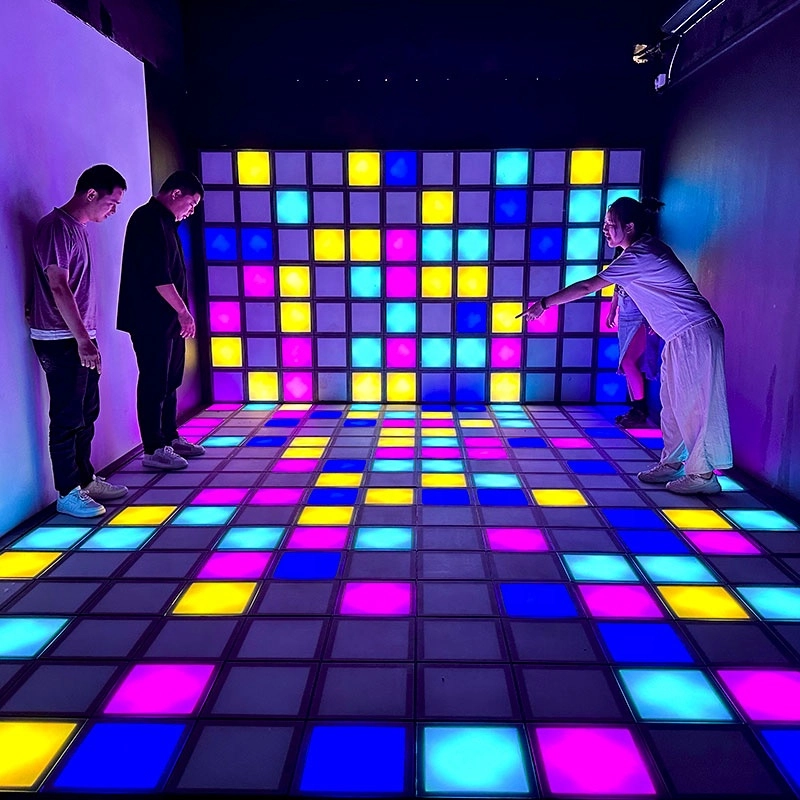
Hottest activated LED dance grid tiles floor touch games
Super Grid is an immersive sports game that combines sports and technology. It integrates interactive LED lights and sensors through innovative software design, creating a fun gaming experience.
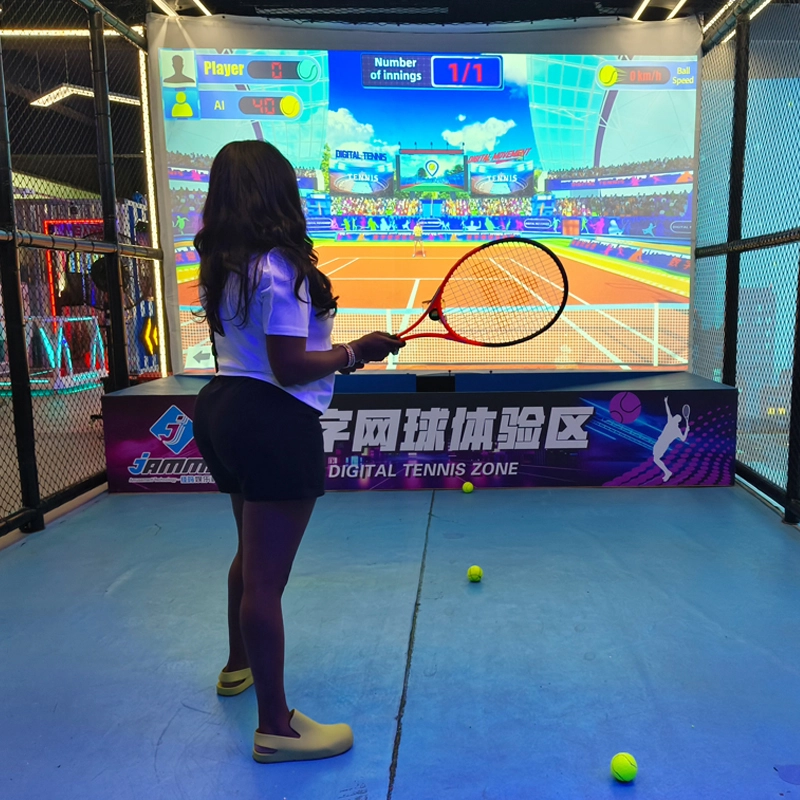
Top Indoor Tennis Racketball Training Simulator Dual Player Games
Interactive somatosensory fitness game
Combine traditional tennis sports with advanced 3D digital technology to bring customers an immersive tennis training experience
COMBINE TRADITIONAL TENNIS SPORTS WITH ADVANCED 3D DIGITAL TECHNOLOGY TO BRING CUSTOMERS AN IMMERSIVE TENNIS TRAINING EXPERIENCE INDOOR AND TENNIS EXPERIENCE HALL
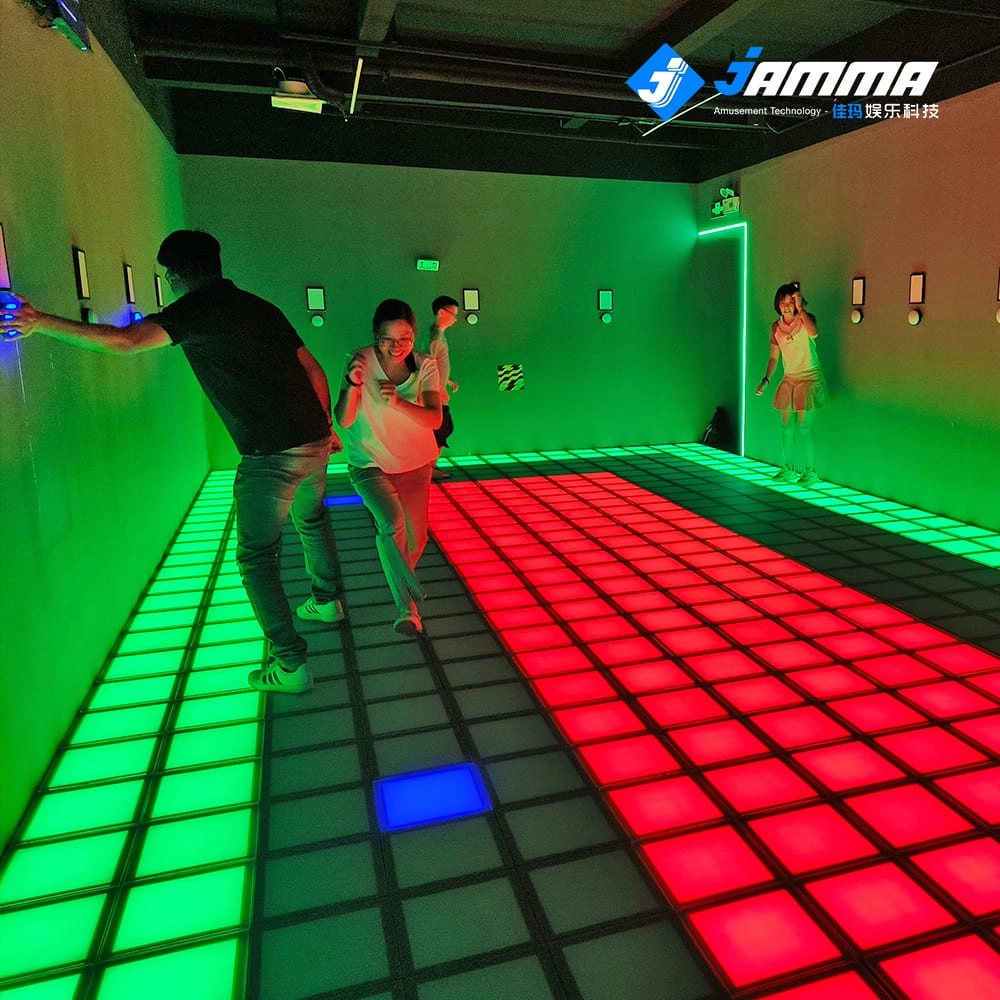
Super Grid Interactive LED Floor Activate Game Team Play
Super Grid is an immersive sports game that combines sports and technology. It integrates interactive LED lights and sensors through innovative software design, creating a fun gaming experience.
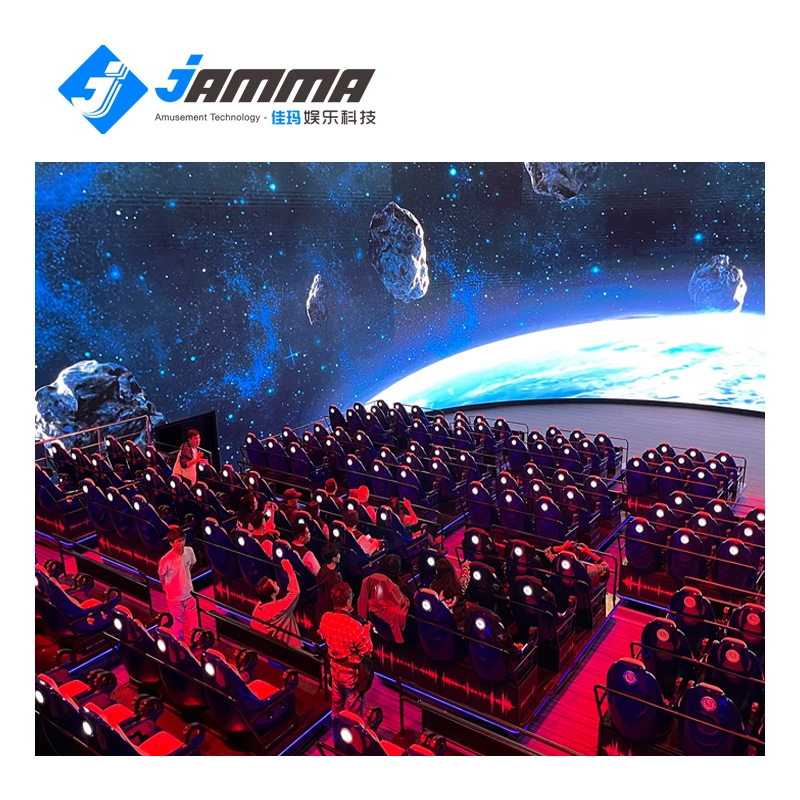
Immersive 5D/7D/9D cinema dynamic visual experience room
Compared with other types of theaters, 5D/7D/9D cinema have high technical content, prominent themes, and have a strong impact on the characteristics of the picture. With the increasing demand in the entertainment market and the continuous development of video entertainment technology, in the past, audiences would experience vibration, drop, rain, scratches and other effects in some 4D theaters, but now with 5D theaters, audiences can experience new Unique features, touch and feel effects such asreal smoke, water, snow, bubbles, smell, lightning, leg touch,camera system and more. When the audience is watching amovie, the seats and environmental effects will change into corresponding actions according to the development of the movie,allowing the audience to experience an immersive viewing experience.
