

Interactive Multiplayer Sports Simulators for Groups
- Designing Group Experiences with Sports Tech
- Why sports simulation attracts groups and venues
- Types of interactive multiplayer sports simulators for groups (sports simulation solutions)
- How to choose sports simulation systems for your venue (buy sports simulation)
- Operational metrics: capacity, footprint, and ROI (sports simulation performance)
- Technology stack and integration — VR, AR, projection and sensors (sports simulation technology)
- Content, gameplay design and multiplayer modes for better retention (sports simulation content)
- Installation, maintenance and safety considerations (sports simulation operations)
- Marketing and monetization strategies for group sports simulation (sports simulation monetization)
- Why choose a proven supplier — the case for JAMMA Amusement (sports simulation vendor)
- How JAMMA’s sports simulators and interactive projection games fit group venues
- Vendor selection checklist for buying sports simulation systems (sports simulation procurement)
- FAQ — Interactive Multiplayer Sports Simulators for Groups
- Contact and demo CTA
- References
Designing Group Experiences with Sports Tech
Sports simulation has evolved from solitary practice tools into high-value, multiplayer attractions that drive footfall, dwell time, and spend for entertainment venues. Group-oriented interactive multiplayer sports simulators combine realistic physics, responsive sensors, immersive visuals, and social gameplay to deliver experiences that appeal to families, parties, corporate groups and competitive players. For venue operators, understanding how to specify, install and monetize these systems determines whether they become headline draws or underutilized machines.
Why sports simulation attracts groups and venues
Sports simulation taps several strong consumer drivers: social competition, skill learning, photogenic moments, and sharable digital results. For operators, multiplayer sports simulators increase revenue per square meter in ways that traditional arcade cabinets or single-player VR sometimes cannot. Key commercial benefits include repeat visits from leagues/tournaments, group bookings for parties and team-building, and High Quality pricing for coached sessions or tournaments. When marketing is aligned with the offering — e.g., leagues, birthday packages, corporate events — operators see improved yield and customer lifetime value.
Types of interactive multiplayer sports simulators for groups (sports simulation solutions)
Not all sports simulation systems serve groups equally. Operators should match the technology with their customer profile and business model. Common categories include:
- Full-scale golf simulators: Multiplayer tee rooms, shot-tracking, and multi-hole competitions.
- Batting and pitching centers: Baseball/softball simulators with group practice and head-to-head play.
- Soccer and football strike zones: Accuracy and power challenges with leaderboards and team modes.
- Multisport kiosks: Small-footprint systems offering multiple sports mini-games for parties.
- AR/Projection interactive courts: Large-area projection enabling team play, cooperative challenges and audience participation.
- VR arenas: Room-scale experiences offering team objectives and competitive matches.
Each form factor brings different capacity and revenue characteristics, discussed below.
How to choose sports simulation systems for your venue (buy sports simulation)
Selecting the right sports simulation solution requires evaluating four vectors: target demographic, footprint and layout, operational model, and return-on-investment expectations.
- Target demographic: Family centers prioritize safety and simplicity; FECs and bars may prefer quick multiplayer party modes; golf and country clubs need high-fidelity shot physics and training tools.
- Footprint: Is your space a compact corner or a dedicated room? Projection-based and AR courts require more open area than kiosks and simulator booths.
- Operational model: Will you run session-based paid play, membership leagues, or free-play with ancillary spending? Booking systems and POS integration capabilities differ by supplier.
- Maintenance and support: Check SLAs, parts availability and the vendor’s international service reach; downtime directly reduces yield.
Operational metrics: capacity, footprint, and ROI (sports simulation performance)
Operators should model throughput, average session length, and expected spend per session to forecast revenue. Below is a practical comparison table that operators can use as a starting point. The numbers are typical ranges observed across commercial deployments; adapt them to local pricing and utilization.
| Simulator Type | Typical Group Size | Average Session Time | Approx. Footprint | Primary Revenue Streams |
|---|---|---|---|---|
| Golf Simulator (multi-tee) | 2–6 players | 30–90 minutes | 20–40 m² per bay | Paid sessions, coaching, F&B packages, leagues |
| Batting / Baseball Center | 1–8 players (lanes) | 10–30 minutes | 6–12 m² per lane | Per-play fees, memberships, leagues |
| Soccer / Strike Zone | 1–4 players | 5–20 minutes | 8–15 m² | Per-play, party bookings, competitions |
| AR Interactive Court / Projection | 4–20 players | 10–45 minutes | 40–200 m² | Group bookings, events, sponsorships |
| VR Arena (team-based) | 2–8 players | 15–40 minutes | 30–100 m² | Timed sessions, parties, corporate events |
Note: Footprint and session times will vary with game design and venue layout. Use pilot installations to validate assumptions before large rollouts.
Technology stack and integration — VR, AR, projection and sensors (sports simulation technology)
Group simulators are complex systems that combine hardware and software. Typical components include:
- Tracking sensors — camera-based, radar, lidar or inertial sensors to capture ball and player movement.
- Physics and simulation engine — calculates realistic ball flight and player feedback; fidelity affects perceived value.
- Rendering and projection — from high-resolution screens in booths to floor/ceiling projections for arenas.
- Networking and multiplayer sync — local area networks or cloud services to manage leaderboards, profiles and remote tournaments.
- Analytics and CRM integration — capture play metrics for targeted marketing and retention programs.
When evaluating vendors, ask for latency measurements, sensor accuracy specs, and how they handle software updates and content delivery. Low latency and robust collision/ball-tracking are essential for believable sports simulation.
Content, gameplay design and multiplayer modes for better retention (sports simulation content)
Content is often the overlooked differentiator. A simulator with realistic physics but thin multiplayer features will struggle to retain groups. Design considerations that improve retention and ARPU (average revenue per user):
- Progression and unlocks — player profiles with skill tracking and badges.
- Multiplayer modes — head-to-head, team objectives, cooperative challenges and tournament brackets.
- Spectator features — large-screen replays, instant highlights, social sharing options to amplify reach.
- Event tooling — built-in utilities for running tournaments, leaderboards and reporting.
Installation, maintenance and safety considerations (sports simulation operations)
Group-focused simulators bring higher throughput and different safety profiles compared with single-player VR. Operators must consider:
- Flooring and impact protection — durable surfaces and padding for active games.
- Clear sightlines and crowd control — separate spectator zones to avoid interference with sensors and ensure safety.
- Noise management — multi-lane environments can get loud; soundproofing or directional audio can improve comfort.
- Serviceability — modular hardware makes on-site repairs faster. Verify the vendor’s spare-parts inventory and typical Mean Time To Repair (MTTR).
- Training and documentation — staff need simple troubleshooting guides and escalation pathways.
Neglecting operational readiness is the main cause of underperforming attractions in busy venues.
Marketing and monetization strategies for group sports simulation (sports simulation monetization)
To maximize revenue, operators should diversify monetization beyond per-play fees:
- Leagues and tournaments — recurring events that create habitual visits.
- Private bookings and parties — tiered packages with food and dedicated hosts.
- Sponsorships and branded events — local brands often sponsor leagues or tournaments.
- High Quality experiences — coaching sessions, pro-mode simulations and recorded highlights for purchase.
- Cross-sell — bundle with escape rooms, bars or F&B to lift total spend.
Use CRM data from the simulation platform to create targeted offers (e.g., skill-level based promotions) and measure LTV by cohort.
Why choose a proven supplier — the case for JAMMA Amusement (sports simulation vendor)
JAMMA Amusement was established in 2009, located in Guangzhou, with 15 years of experience in the amusement industry. Focusing on providing high-value, one-stop solutions for amusement projects, our products include VR games, AR sports simulators, AR interactive projection games, 5D cinema, as well as arcade games and outdoor playground equipment. We have a highly efficient international sales team dedicated to understanding customer needs and providing professional solutions and high-quality products for venues. Our industry-leading technical team keeps abreast of the latest technological trends and continuously develops and updates the products. Our manufacturing and after-sales teams are skilled and experienced, providing comprehensive technical support. We are committed to becoming a leading global provider of amusement equipment and park solutions. Our website is https://www.jammapark.com/.
JAMMA’s competitive advantages summarized:
- 15+ years of industry experience and a one-stop solution model to reduce vendor complexity for operators.
- Product breadth across Sports Simulators, Interactive Projection Games, Immersive Attractions and VR Games, enabling bundled offerings.
- Dedicated international sales and technical teams to support specification, installation and lifecycle updates.
- Manufacturing and after-sales capability to minimize downtime and protect revenue flows.
How JAMMA’s sports simulators and interactive projection games fit group venues
JAMMA’s products can be configured for small-party kiosks to large AR projection courts. Typical implementations include multi-bay golf rooms for clubs, soccer accuracy courts for family entertainment centers, and adaptable projection arenas for shopping mall events and corporate team-building. Combining hardware reliability and content update pipelines, JAMMA supports seasonal campaigns and local customization to keep attractions fresh.
Vendor selection checklist for buying sports simulation systems (sports simulation procurement)
Before signing, verify the following with any supplier:
- Proof points: case studies and references from venues with similar profiles.
- Uptime and SLA commitments, local spare parts and technician availability.
- Software roadmap and update policy — who pays for new features or content packs?
- Integration capability — POS, booking systems and CRM hooks.
- Training and marketing support for launch and ongoing promotions.
FAQ — Interactive Multiplayer Sports Simulators for Groups
Q1: What is the typical payback period for a group sports simulator?
Payback varies with location, pricing and utilization. In high-traffic FECs or malls, a well-marketed simulator bay or AR court can pay back in 12–36 months. Model conservatively using low initial utilization (20–30% of available hours) and incremental revenue streams (events, parties).
Q2: How many players can a sports simulator serve at once?
Depends on the system. Kiosks typically serve 1–4; multi-bay golf rooms 2–6 per bay; projection courts and VR arenas can serve 4–20+ depending on game design.
Q3: Are sports simulators suitable for outdoor use?
Most precision sensor systems are designed for indoor environments to control lighting and surfaces. Some robust AR projection and simple ball-tracking kiosks can work outdoors with weather protection; consult the vendor on IP ratings and calibration.
Q4: How important is content refresh for retention?
Very important. New game modes, seasonal themes and leaderboard resets drive repeat visits. Vendors that provide frequent content updates or support custom event tooling deliver better long-term ARPU.
Q5: What are the main safety risks and mitigation measures?
Risks include player collisions, ball ricochet and slips. Mitigation includes adequate padding, controlled ball containment, clear operational rules, trained staff, and routine safety checks.
Q6: Can sports simulators integrate with my existing booking/POS system?
Many commercial suppliers offer APIs or integrations with common POS and booking platforms. Verify compatibility during procurement and request sandbox/testing access before deployment.
Contact and demo CTA
If you are evaluating group-focused sports simulation solutions for an FEC, mall activation, club or training center, JAMMA Amusement can provide turnkey proposals, case studies and on-site/remote demos. Visit https://www.jammapark.com/ to view product portfolios, or contact their international sales team to schedule a consultation and ROI model tailored to your venue.
References
- AEcom / Themed Entertainment Association (TEA) Theme Index and Museum Index — industry attendance and trends. (https://aecom.com/tea/, accessed June 2024)
- Grand View Research — Virtual Reality Market Size, Share & Trends Analysis (market sizing and growth of immersive technologies). (https://www.grandviewresearch.com/industry-analysis/virtual-reality-vr-market, accessed June 2024)
- PwC — Global Entertainment & Media Outlook (industry revenue trends and forecasts). (https://www.pwc.com/gx/en/industries/tmt/media/outlook., accessed June 2024)
- JAMMA Amusement official website — company profile and product lines. (https://www.jammapark.com/, accessed June 2024)
How to Choose the 7d dark rides manufacturer and supplier ?
Top 10 interactive wall projector games Manufacturers and Supplier Brands in Germany
Top dark rides Manufacturers and Suppliers in Europe
Why choose JAMMA as your immersive restaurant supplier
Standard and other
How will it be transported?
For large items, we usually use sea freight, while for small items, we use air freight or services like DHL, FedEx, or UPS. We can also accommodate specific shipping methods based on your requirements.
How long is the warranty period?
Our products have a one-year warranty period. During the warranty period, if there are any issues with the product that are not caused by human error, we can replace the parts for you free of charge. If the problems are caused by improper use, you will need to purchase the parts and bear the shipping costs yourself.
Are you an amusement park equipment manufacturer?
Yes. We have our own production factory, which is located in Guangzhou, China, covering an area of over 2,000 square meters. With our professional production team, we are able to ensure high quality and on-time delivery of our products. All products have undergone rigorous testing and quality inspection. You are welcome to visit our factory.
Product details
How many players can play soccer at the same time?
Up to 4 players can play at the same time, you need to add more soccer balls.
Are glasses required to see a 5D film?
Audience needs to wear 3D glasses while watching movie, but not VR glasses.
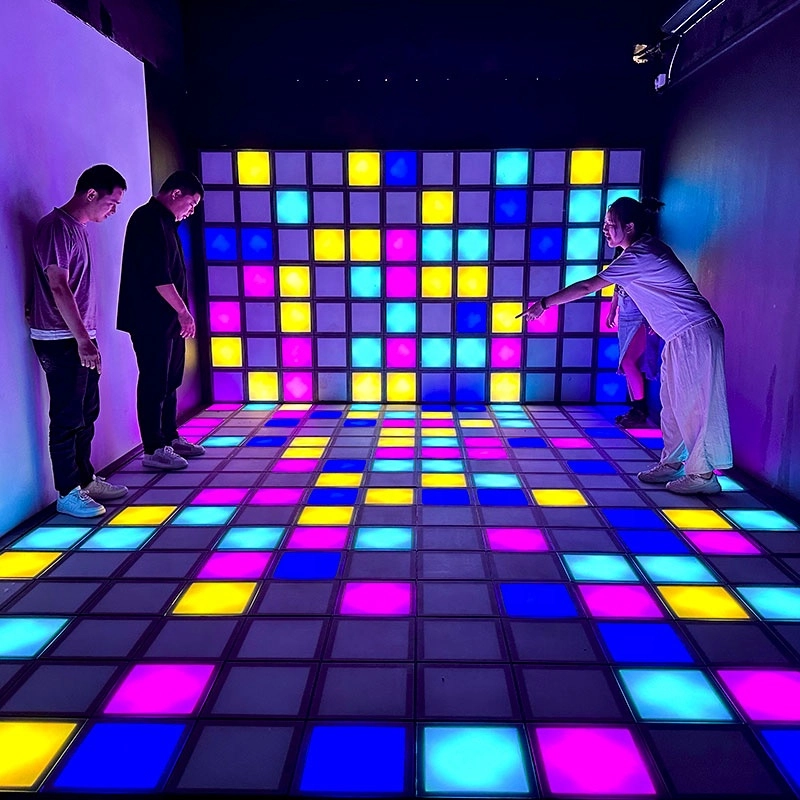
Hottest activated LED dance grid tiles floor touch games
Super Grid is an immersive sports game that combines sports and technology. It integrates interactive LED lights and sensors through innovative software design, creating a fun gaming experience.
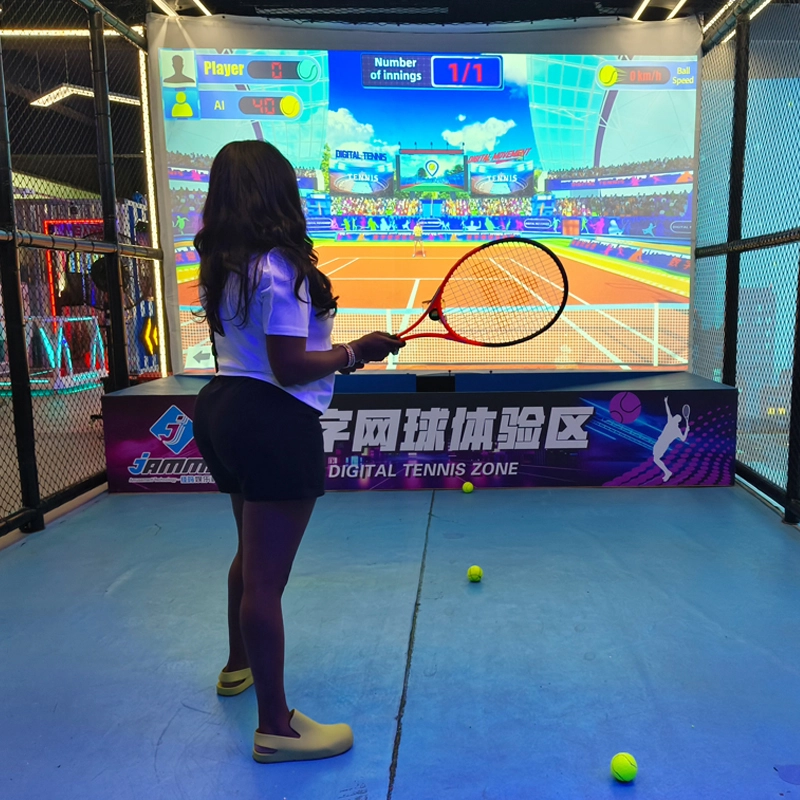
Top Indoor Tennis Racketball Training Simulator Dual Player Games
Interactive somatosensory fitness game
Combine traditional tennis sports with advanced 3D digital technology to bring customers an immersive tennis training experience
COMBINE TRADITIONAL TENNIS SPORTS WITH ADVANCED 3D DIGITAL TECHNOLOGY TO BRING CUSTOMERS AN IMMERSIVE TENNIS TRAINING EXPERIENCE INDOOR AND TENNIS EXPERIENCE HALL
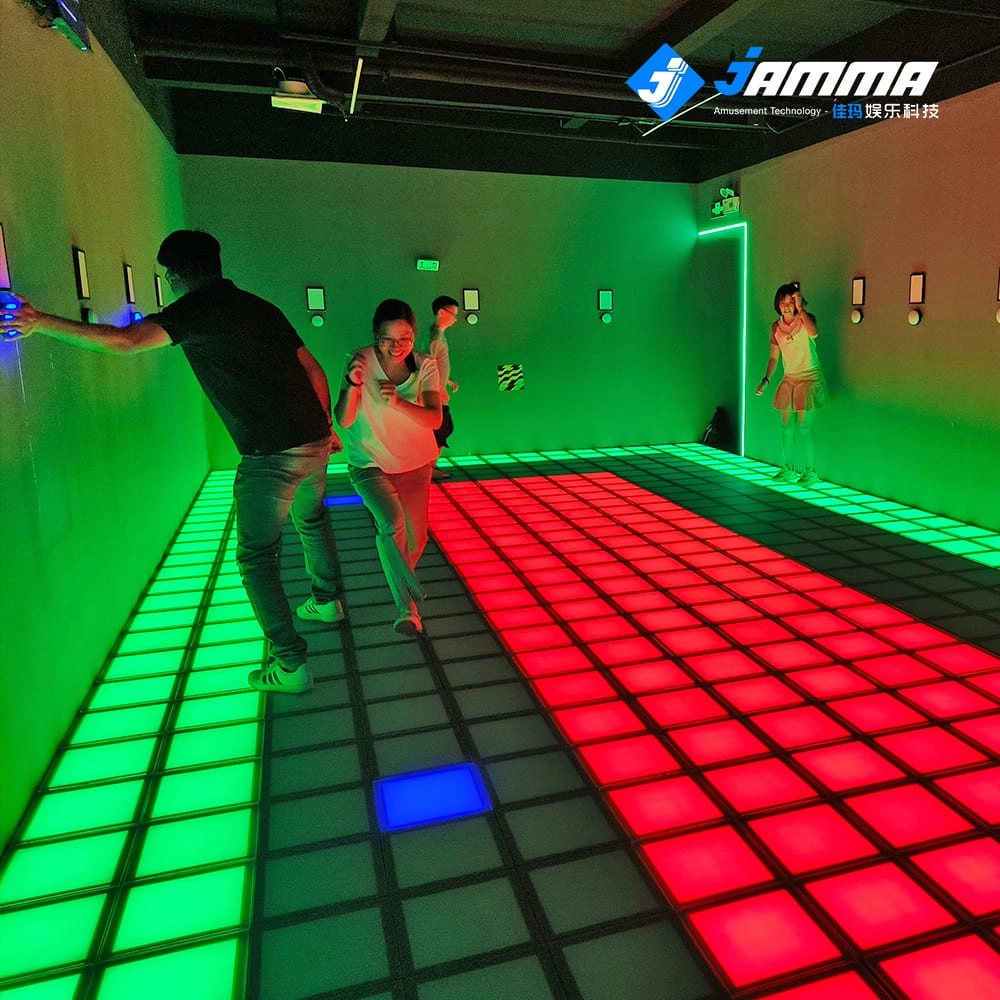
Super Grid Interactive LED Floor Activate Game Team Play
Super Grid is an immersive sports game that combines sports and technology. It integrates interactive LED lights and sensors through innovative software design, creating a fun gaming experience.
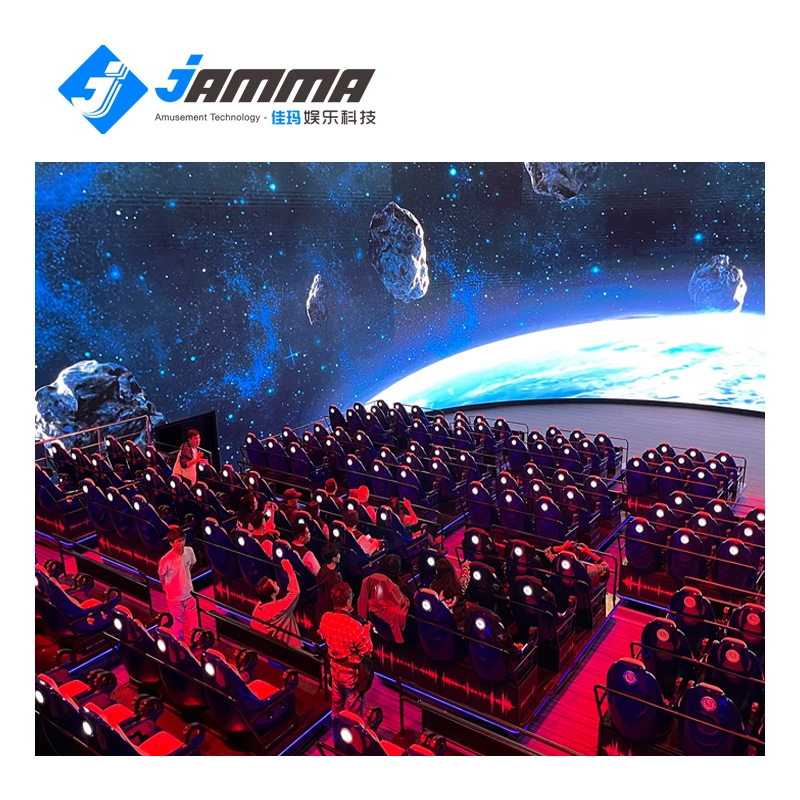
Immersive 5D/7D/9D cinema dynamic visual experience room
Compared with other types of theaters, 5D/7D/9D cinema have high technical content, prominent themes, and have a strong impact on the characteristics of the picture. With the increasing demand in the entertainment market and the continuous development of video entertainment technology, in the past, audiences would experience vibration, drop, rain, scratches and other effects in some 4D theaters, but now with 5D theaters, audiences can experience new Unique features, touch and feel effects such asreal smoke, water, snow, bubbles, smell, lightning, leg touch,camera system and more. When the audience is watching amovie, the seats and environmental effects will change into corresponding actions according to the development of the movie,allowing the audience to experience an immersive viewing experience.
