

Tech Integration: AR/VR in Indoor Play Centers
- Why Tech-Forward Play Matters
- The changing expectations of families visiting an Indoor Playground
- What AR and VR Bring to Indoor Playgrounds
- Core use cases and visitor benefits
- Designing AR/VR Experiences for an Indoor Playground
- Experience-first design principles
- Hardware and Software Considerations
- Choosing the right tech for your Indoor Playground
- Safety, Accessibility and Operational Best Practices
- Minimizing risk while maximizing fun
- Monetization and ROI Models for AR/VR Attractions
- Pricing strategies and KPI framework
- Case Examples and Deployment Patterns
- High-impact formats for Indoor Playground operators
- Technology Comparison: AR vs VR for Indoor Playgrounds
- Choosing the right modality
- Implementing a Rollout Plan for an Indoor Playground
- Step-by-step deployment checklist
- JAMMA Amusement: Solutions & Competitive Advantages for Indoor Playgrounds
- 15 years’ industry expertise and one-stop solutions
- Measuring Success and Continuous Improvement
- From metrics to strategic growth
- Frequently Asked Questions (FAQ)
- 1. How much space do I need for a VR attraction in an Indoor Playground?
- 2. Are AR/VR attractions safe for young children?
- 3. What are realistic payback periods for AR/VR installations?
- 4. How do I manage hygiene for shared headsets?
- 5. Can AR/VR be integrated with existing attractions?
- 6. How do I choose between AR and VR for my venue?
- Contact & Next Steps
- References
Why Tech-Forward Play Matters
The changing expectations of families visiting an Indoor Playground
Today’s families expect more than soft play and ball pits. Operators of an Indoor Playground must balance active play, digital engagement, safety, and clear revenue pathways. Augmented Reality (AR) and Virtual Reality (VR) enable unique, repeatable experiences that increase dwell time, per-visit spend, and return visits — when implemented with careful design and operational planning.
What AR and VR Bring to Indoor Playgrounds
Core use cases and visitor benefits
AR and VR add four principal value layers for an Indoor Playground:
- Immersive storytelling and themed attractions (VR escapes, ride-like simulators)
- Mixed physical-digital play that combines climbing or running with AR overlays
- Skill and sports training via AR sports simulators for older kids and adults
- Interactive projection and motion-tracking games suitable for mixed-age groups
These capabilities translate into measurable benefits: higher ticket High Qualitys for signature attractions, longer session times, increased F&B and retail conversion, and more social sharing (free marketing).
Designing AR/VR Experiences for an Indoor Playground
Experience-first design principles
Start with a clear audience segmentation: toddlers (0–4), early childhood (5–8), pre-teens (9–12), teens & adults. For each segment, define:
- Physical activity level required
- Session length (5–15 min for VR rides; 10–40 min for multi-station AR play)
- Throughput goals (players/hour per unit)
- Safety and supervision needs
Design tips:
- Layer digital content on clear physical cues to avoid cognitive overload for younger children
- Use short, repeatable loops for high-turn attractions
- Provide parallel low-tech options to avoid bottlenecks and keep companions engaged
Hardware and Software Considerations
Choosing the right tech for your Indoor Playground
Operators must match technology to business goals: immersive signature experiences justify higher capital costs; interactive projection and AR overlays offer scalable, lower-risk installations. Key considerations include headset hygiene, latency, maintenance, content updateability, and space footprint.
| Technology | Typical Cost Range (capex) | Throughput | Best fit for | Main operational notes |
|---|---|---|---|---|
| Standalone VR headsets (e.g., Oculus/Meta Quest class) | $400–$1,200 per unit | 10–30 players/hr (per headset) | Compact VR rides, free-roam booths | Hygiene protocols, battery management, content updates |
| PC-tethered VR systems | $1,500–$6,000 per station | 8–20 players/hr | High-fidelity simulation, long sessions | Higher maintenance, dedicated space, cooling |
| AR sports simulators | $10,000–$80,000 per bay | 15–40 players/hr (depending on format) | Revenue-generating sports training zones | High ticket price potential, staff-assisted |
| Interactive projection & motion tracking | $5,000–$30,000 per zone | 30–100 players/hr | Family play floors, large-group games | Low barriers to entry, scalable |
Sources for cost and throughput ranges: vendor pricing, industry case studies, and market overviews (see references).
Safety, Accessibility and Operational Best Practices
Minimizing risk while maximizing fun
Safety is non-negotiable in an Indoor Playground. AR/VR introduces new vectors: collision risk (in free movement VR), motion sickness (latency-induced discomfort), and infection control (shared headsets). Implement:
- Clear physical boundaries, padded zones, and staff-monitored ingress/egress
- Latency-targeted hardware: aim for display latency <20 ms for most VR (lower is better)
- Hygiene SOPs: replaceable face pads, UV/chemical sterilization, disposable liners
- Inclusive design: seated VR options, simplified AR modes, multi-sensory cues for neurodiverse visitors
Refer to playground safety guidelines such as ASTM F1487 and general public playgrounds guidance from consumer safety agencies for baseline compliance. (See references.)
Monetization and ROI Models for AR/VR Attractions
Pricing strategies and KPI framework
AR/VR can be monetized via:
- High Quality-time tickets (add-on attraction pricing)
- Memberships with discounted visits
- Event bookings and private sessions
- Cross-sell: food, retail, photo/AR souvenirs
Core KPIs to monitor:
- Revenue per visit (including add-ons)
- Attraction utilization rate (occupied minutes / available minutes)
- Customer acquisition cost (ad spend / new members)
- Net promoter score (NPS) and repeat visit rate
Market context: the combined AR/VR market shows strong growth — multiple industry reports project CAGR in double digits through the mid-2020s — supporting viable ROI timelines for differentiated attractions (see references).
Case Examples and Deployment Patterns
High-impact formats for Indoor Playground operators
Successful deployment patterns include:
- Signature VR ride as an anchor attraction that justifies High Quality tickets
- Scattered AR interactions across play zones to encourage exploration and extend dwell time
- Dedicated sports-simulator bays for older kids and family competition
- Interactive projection floors for birthday groups and bulk throughput
Real-world examples of immersive entertainment driving traffic are documented by industry bodies (IAAPA) and market analysts. Operators should pilot one or two formats, measure throughput and guest satisfaction, then iterate content and pricing.
Technology Comparison: AR vs VR for Indoor Playgrounds
Choosing the right modality
| Criteria | Augmented Reality (AR) | Virtual Reality (VR) |
|---|---|---|
| Immersion | Enhances real world, shared experiences | Full immersion, isolated experience |
| Throughput | Higher (less prep time) | Lower (sanitation, fitting headsets) |
| Safety | Lower risk (visibility retained) | Higher risk for collisions, motion sickness |
| Content flexibility | Easy to update and overlay | High fidelity experiences but heavier updates |
| Initial cost | Moderate | Moderate to high |
Implementing a Rollout Plan for an Indoor Playground
Step-by-step deployment checklist
- Start with a business case: define revenue targets, expected utilization, and acceptable payback period.
- Run a small pilot in a controlled zone with clear measurement of throughput and guest satisfaction.
- Train staff for operation, hygiene, and assistance; prepare SOPs for safety incidents.
- Measure KPIs for 90 days and iterate content, pricing, and queueing systems.
- Scale gradually, reinvesting a portion of incremental revenue into content refresh and marketing.
JAMMA Amusement: Solutions & Competitive Advantages for Indoor Playgrounds
15 years’ industry expertise and one-stop solutions
JAMMA Amusement was established in 2009 in Guangzhou and brings 15 years of experience in the amusement industry. JAMMA focuses on delivering high-value, one-stop solutions for indoor playgrounds and amusement projects. Their product portfolio aligns closely with the AR/VR strategies discussed above, including:
- VR Games — immersive rides and booth experiences
- AR Sports Simulators — configurable bays for training and competition
- AR Interactive Projection Games — scalable family play floors and birthday attractions
- 5D Cinema — group immersion with motion and sensory effects
- Arcade games and outdoor playground equipment for complementary revenue streams
JAMMA’s operational strengths:
- A highly efficient international sales team focused on understanding customer needs
- An industry-leading technical team that continuously develops and updates products to reflect new tech trends
- Experienced manufacturing and after-sales teams providing comprehensive technical support
Competitive differentiation and technical capabilities:
- End-to-end project support — from design and simulation to installation and training
- Modular solutions that allow phased investment (pilot to full park)
- Proven ability to integrate AR/VR with projection and physical play systems to boost throughput and guest satisfaction
Their main product advantages specifically relevant to Indoor Playground operators include Sports Simulators, Interactive Projection Games, Immersive Attractions, and VR Games — all optimized for safety, uptime, and commercial viability. For more information, visit https://www.jammapark.com/.
Measuring Success and Continuous Improvement
From metrics to strategic growth
After launch, prioritize the following:
- Daily and weekly utilization dashboards
- Guest feedback loops (in-app, kiosk or staff-collected)
- Lifecycle content roadmap — seasonal themes, tournaments, and tournaments
- Maintenance and spare-parts forecasting to maximize uptime
Frequently Asked Questions (FAQ)
1. How much space do I need for a VR attraction in an Indoor Playground?
Depends on format: a seated VR booth needs as little as 6–10 sqm, while a free-roam or tracked VR room requires 25–100+ sqm plus buffer zones. Consider queueing, safety zones, and staff oversight.
2. Are AR/VR attractions safe for young children?
AR is generally safer for younger visitors because visual awareness of surroundings is maintained. VR is suitable for older children who can follow safety instructions and tolerate headset use; include age limits and parental consent as policy.
3. What are realistic payback periods for AR/VR installations?
Payback depends on capital cost, pricing, and utilization. Small interactive projection or AR overlays may pay back within 12–24 months. High-end VR or sports simulator bays often target 18–36 months based on conservative utilization assumptions.
4. How do I manage hygiene for shared headsets?
Implement replaceable face pads, disposable liners, scheduled UV or chemical disinfection between sessions, and clear guest expectations. Staff training and visible cleaning procedures build guest trust.
5. Can AR/VR be integrated with existing attractions?
Yes. AR overlays and projection systems are often retrofitted into existing play areas. VR attractions may require dedicated space but can be installed alongside other offerings to create a layered guest experience.
6. How do I choose between AR and VR for my venue?
Choose AR to scale throughput, maintain shared experiences, and minimize safety complexity. Choose VR when seeking signature, high-margin attractions with deep immersion and storytelling value. Many operators combine both for complementary offerings.
Contact & Next Steps
If you’re planning to upgrade an Indoor Playground with AR/VR, JAMMA Amusement offers consultative planning, hardware and content solutions, and global project execution. Contact JAMMA to discuss site surveys, pilot programs, and turnkey installation: https://www.jammapark.com/.
References
- Statista — Global augmented reality (AR) and virtual reality (VR) market size 2016-2026. Link: https://www.statista.com/statistics/591181/global-augmented-reality-and-virtual-reality-market-size/ (accessed 2025-12-16)
- Grand View Research — Augmented Reality Market Size & Share Report. Link: https://www.grandviewresearch.com/industry-analysis/augmented-reality-ar-market (accessed 2025-12-16)
- IAAPA — Industry insights and trends for attractions and family entertainment centers. Link: https://www.iaapa.org/ (accessed 2025-12-16)
- U.S. Consumer Product Safety Commission — Public Playground Safety Handbook (guidance for playground safety and surfacing). Link: https://www.cpsc.gov/s3fs-public/325.pdf (accessed 2025-12-16)
- ASTM International — ASTM F1487 - Standard Consumer Safety Performance Specification for Playground Equipment for Public Use. Link: https://www.astm.org/Standards/F1487.htm (accessed 2025-12-16)
- UNICEF — The Importance of Play in Promoting Healthy Child Development and Maintaining Strong Parent-Child Bond. Link: https://www.unicef.org/parenting/importance-play (accessed 2025-12-16)
- PwC — Seeing is believing: How VR and AR will transform business and the economy (industry report). Link: https://www.pwc.com/gx/en/industries/technology/publications/seeing-is-believing. (accessed 2025-12-16)
Custom high quality interactive dance floor led Manufacturers and Suppliers
The latest trends for soft play indoor playground equipment for infants in 2026 us | JAMMA Ultimate Insights
Wholesale interactive projection table manufacturer and supplier
Sports Simulation VR Experiences for Entertainment Venues
Product details
Does the soccer simulator configuration include the curtain?
Yes, a 4-meter-wide, 3-meter-high projection curtain is included.
Are glasses required to see a 5D film?
Audience needs to wear 3D glasses while watching movie, but not VR glasses.
Can I customize the number of seats of 5D cinema?
Yes, we generally have options for six, nine, eighteen, twenty-four, and thirty-six seats, and the quantity of seats also can be customized.
Standard and other
Do you offer installation services?
Our professional implementation team can provide equipment installation and debugging services to ensure smooth operation. Our installation services is chargeable and you can contact us in to inquire about the service fees.
Are you an amusement park equipment manufacturer?
Yes. We have our own production factory, which is located in Guangzhou, China, covering an area of over 2,000 square meters. With our professional production team, we are able to ensure high quality and on-time delivery of our products. All products have undergone rigorous testing and quality inspection. You are welcome to visit our factory.
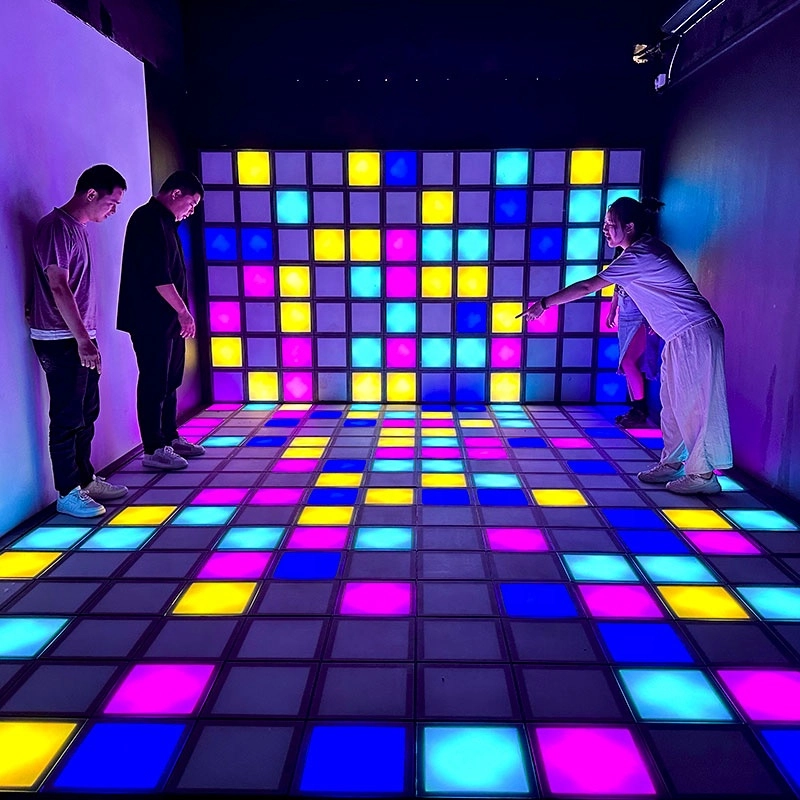
Hottest activated LED dance grid tiles floor touch games
Super Grid is an immersive sports game that combines sports and technology. It integrates interactive LED lights and sensors through innovative software design, creating a fun gaming experience.
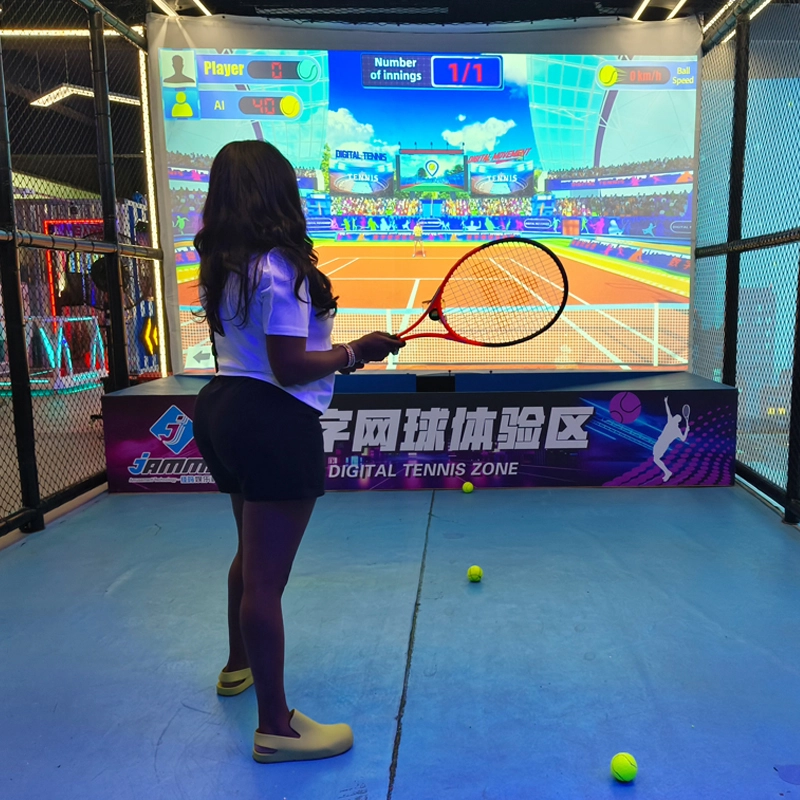
Top Indoor Tennis Racketball Training Simulator Dual Player Games
Interactive somatosensory fitness game
Combine traditional tennis sports with advanced 3D digital technology to bring customers an immersive tennis training experience
COMBINE TRADITIONAL TENNIS SPORTS WITH ADVANCED 3D DIGITAL TECHNOLOGY TO BRING CUSTOMERS AN IMMERSIVE TENNIS TRAINING EXPERIENCE INDOOR AND TENNIS EXPERIENCE HALL
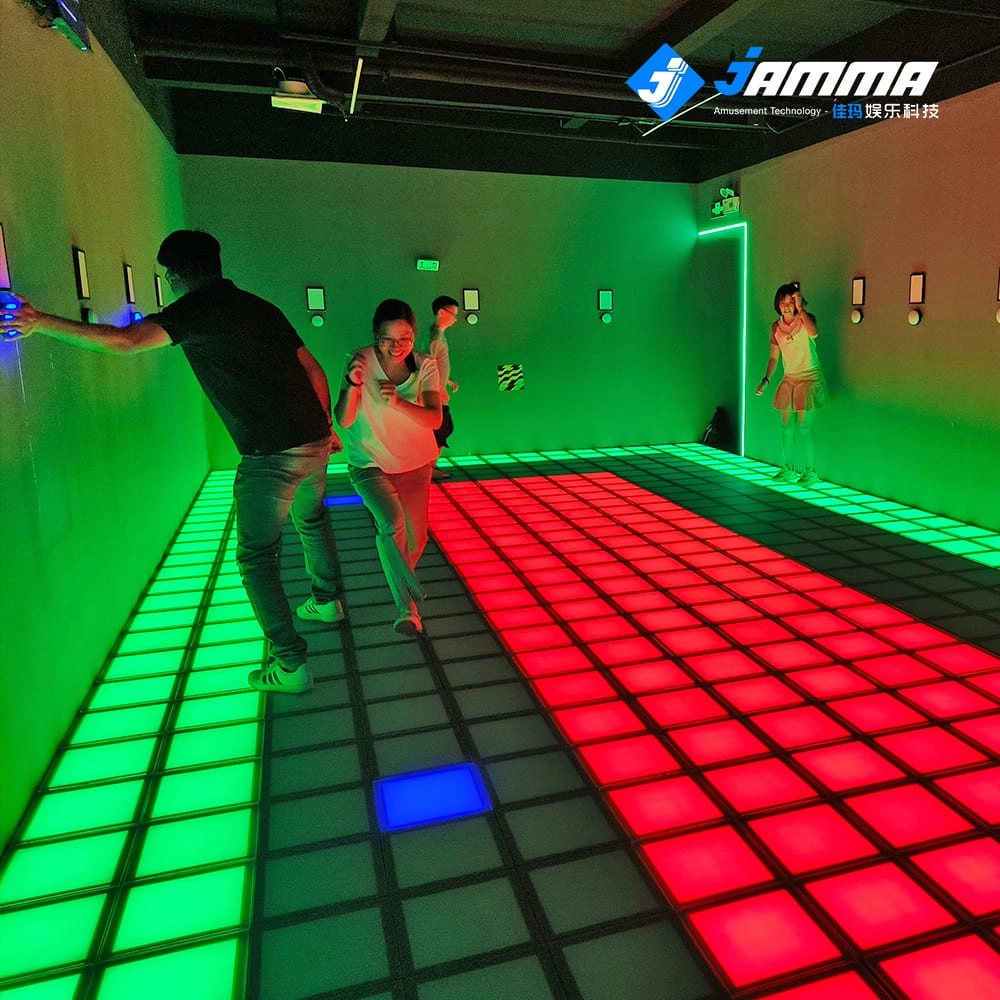
Super Grid Interactive LED Floor Activate Game Team Play
Super Grid is an immersive sports game that combines sports and technology. It integrates interactive LED lights and sensors through innovative software design, creating a fun gaming experience.
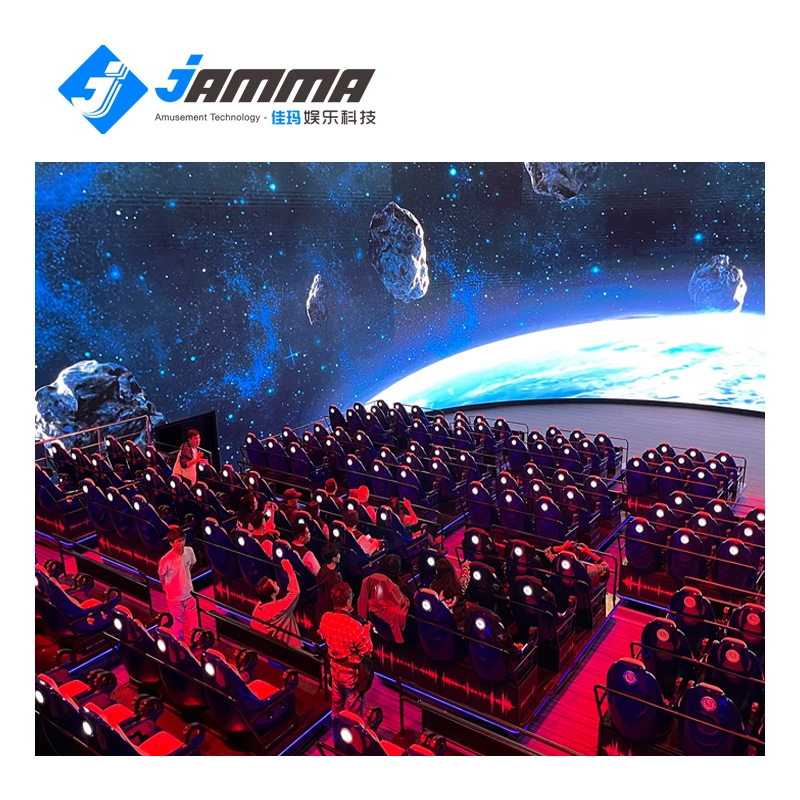
Immersive 5D/7D/9D cinema dynamic visual experience room
Compared with other types of theaters, 5D/7D/9D cinema have high technical content, prominent themes, and have a strong impact on the characteristics of the picture. With the increasing demand in the entertainment market and the continuous development of video entertainment technology, in the past, audiences would experience vibration, drop, rain, scratches and other effects in some 4D theaters, but now with 5D theaters, audiences can experience new Unique features, touch and feel effects such asreal smoke, water, snow, bubbles, smell, lightning, leg touch,camera system and more. When the audience is watching amovie, the seats and environmental effects will change into corresponding actions according to the development of the movie,allowing the audience to experience an immersive viewing experience.
