

Ultimate Golf Simulator Room Dimensions Guide (2025): Size, Height, and Brand Specs
- Introduction: Why Dimensions Are Your First Handicap
- Understanding "Swing Anxiety"
- Overview of Critical Axes
- The Golden Numbers: Universal Minimum vs. Ideal Dimensions
- Ceiling Height: The Vertical Limit
- Room Width: Centered vs. Offset
- Total Depth: The Buffer Zones
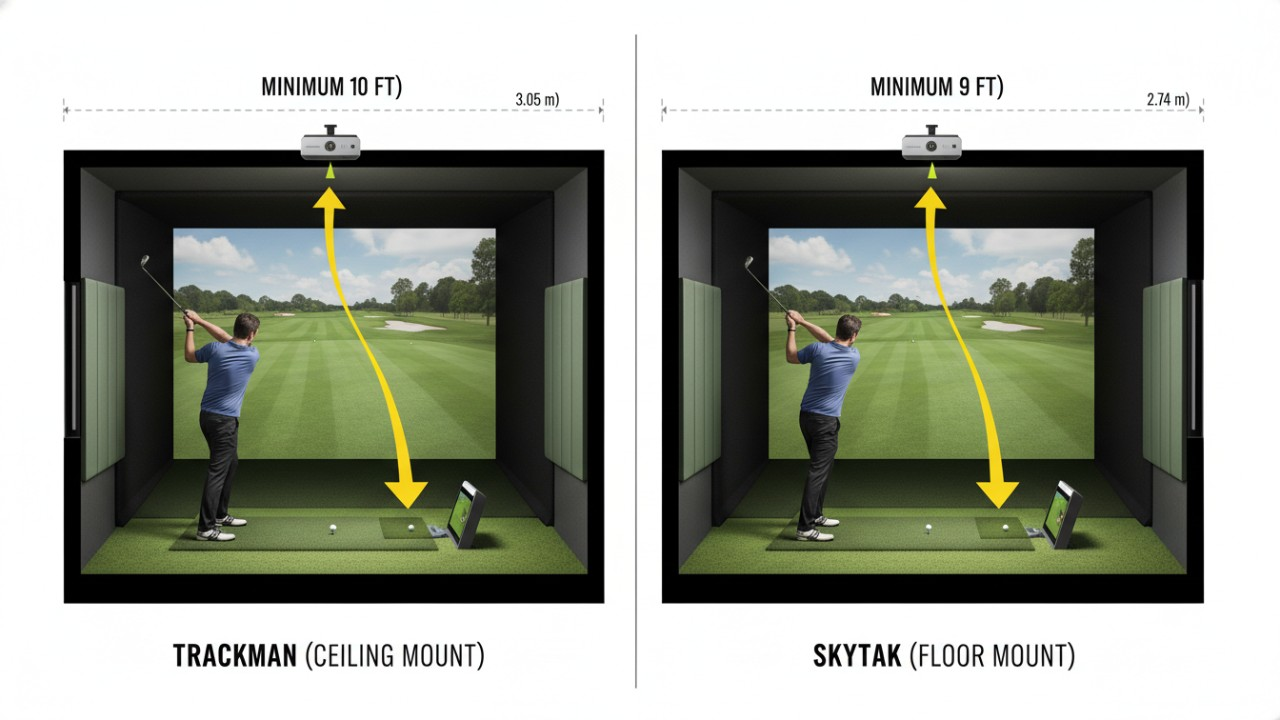
- Technology Dictates Space: Radar vs. Photometric Sensors
- Radar Systems (e.g., Trackman, FlightScope)
- Photometric/Camera Systems (e.g., SkyTrak, Foresight, Uneekor)
- Comparison Chart Logic
- Brand-Specific Space Requirements
- Trackman 4 & iO
- SkyTrak+ & Foresight GCQuad / GC3
- Garmin Approach R10
- Adapting Your Space: Garage & Basement Challenges
- Overhead Obstacles
- Flooring and Leveling
- Lighting Considerations
- The Invisible Essentials: Power, Data, and Ergonomics
- Wi-Fi and Data
- Power Placement
- Spectator Ergonomics
- Conclusion
- FAQs
- Contact Us
Building a home golf simulator is the ultimate dream for many amateurs and professionals alike. It promises the ability to practice 365 days a year, regardless of weather. However, the difference between a frustrating, claustrophobic setup and a world-class training environment often comes down to a few inches of clearance.
Before you purchase a launch monitor or a high-end impact screen, you must understand that physical space is your primary constraint. This guide dives deep into the minimum ceiling height for golf simulator builds, the nuances of Trackman vs SkyTrak space requirements, and how to design the perfect garage golf simulator layout.
Introduction: Why Dimensions Are Your First Handicap
Most golfers assume the most important part of a simulator build is the technology—the launch monitor or the projector resolution. In reality, the most critical factor is the volume of the room. The impact of space on game immersion and physical safety cannot be overstated. If a room is too narrow, you risk damaging walls; if it is too short, the ball may ricochet dangerously.
Understanding "Swing Anxiety"
Perhaps the most overlooked aspect of simulator dimensions is a psychological phenomenon known as "Swing Anxiety." When a player perceives that the ceiling is too low or the back wall is too close, their subconscious alters their body mechanics to avoid a collision.
Even if you physically have enough space to swing, the feeling of being enclosed can ruin your swing mechanics. You might flatten your swing plane or hold back on your follow-through. To maintain a natural, fluid motion, your swing path clearance must be sufficient not just for the club, but for your peace of mind.
Overview of Critical Axes
To calculate your indoor golf room size calculator metrics accurately, we must look at the room in three dimensions:
1. Height: The vertical clearance required for a driver swing.
2. Width: The lateral space needed for left/right-handed usage and off-center hits.
3. Depth: The total length required for the sensor to track the ball and for the screen to absorb the impact safely.
The Golden Numbers: Universal Minimum vs. Ideal Dimensions
While every room is unique, the simulator industry has converged on a set of "Golden Numbers" that serve as safe baselines.
Ceiling Height: The Vertical Limit
The absolute most common question is about vertical clearance. While some manufacturers claim lower heights are acceptable, real-world physics suggests otherwise.
· The Safe Baseline (9 Feet): For most golfers of average height (approx. 5'9"), a 9-foot ceiling is the functional minimum. This allows for a comfortable swing with irons and woods. However, taller golfers or those with a steep, vertical swing plane may still feel cramped.
· The Optimal Standard (10+ Feet): To completely eliminate swing anxiety and accommodate any guest, 10 feet (approx. 3 meters) is the gold standard. This height aligns with standard architectural recommendations for recreational spaces.
According to data on Anthropometry, the average human arm span and height are correlated. A 6-foot golfer swinging a 45-inch driver creates a massive vertical arc. If your ceiling is 8'6", you are statistically likely to strike the drywall or the projector eventually.
Room Width: Centered vs. Offset
Width requirements depend heavily on whether you need to accommodate both left and right-handed players.
· Single-Player/Offset Setup (10-12 Feet): If you are the sole user (or all users share your handedness), you can offset the hitting mat to one side. This allows you to stand closer to a wall (safely away from the swing path) while the ball is hit toward the center of the screen.
· Dual-Handed/Centered Setup (15+ Feet): To have a truly professional setup where the ball is hit from the center of the room for both lefties and righties, you need 15 feet of width. This ensures that when a left-hander swings, their backswing doesn't hit the left wall, and vice-versa for right-handers.
Total Depth: The Buffer Zones
Depth is the sum of three distinct zones:
1. Rear Safety Zone (6-7 ft): Space behind the golfer for the backswing and spectators.
2. Hitting Zone (Desired Flight): The distance from the tee to the screen.
3. Impact Buffer (1-2 ft): The space between the impact screen and the hard wall behind it.
Crucial Note: Never mount an impact screen directly against a concrete wall. You need at least 12 inches of buffer space to allow the screen to deform and absorb energy, a principle rooted in Impulse and Momentum physics. Without this, the ball will rebound at dangerous speeds.
Technology Dictates Space: Radar vs. Photometric Sensors
Your room dimensions will dictate which technology you can buy. The debate of Trackman vs SkyTrak space requirements essentially boils down to the difference between Doppler Radar and Photometric Camera systems.
Radar Systems (e.g., Trackman, FlightScope)
Radar systems utilize the Doppler effect to track the ball's flight. The unit sits behind the player and "watches" the ball fly into the screen.
· Space Requirement: High.
· The "Flight" Constraint: Radar needs to see the ball rotate to calculate spin axis and spin rate accurately. Generally, these systems require a minimum of 8 to 10 feet of ball flight (tee to screen).
· Total Depth: You also need 6 to 8 feet behind the tee for the unit to sit. This brings the total required room depth to 16–20 feet.
Photometric/Camera Systems (e.g., SkyTrak, Foresight, Uneekor)
These systems use high-speed Photogrammetry to take thousands of images per second at the moment of impact. They sit beside the ball (or overhead) and measure the club and ball data immediately.
· Space Requirement: Low.
· The Advantage: Since they measure impact rather than flight, they do not need a long ball flight distance. You only need enough distance to swing the club and not hit the screen (usually 8-10 feet).
· Total Depth: These units can often function effectively in rooms with a total depth of 12 feet, making them ideal for smaller bedrooms or tight garages.
Comparison Chart Logic
|
Feature |
Radar (Trackman/FlightScope) |
Camera (SkyTrak/Foresight) |
|
Sensor Position |
Behind the player |
Beside the ball / Overhead |
|
Min. Flight Distance |
8-10 ft (Critical for accuracy) |
N/A (Impact based) |
|
Total Room Depth |
16+ ft recommended |
12+ ft possible |
|
Ideal For |
Large basements, Outdoor use |
Tight spaces, Garages |
Brand-Specific Space Requirements
To ensure your indoor golf room size calculator is accurate, here are the specific 2025 specifications for the market-leading devices.
Trackman 4 & iO
The Trackman systems are the gold standard for accuracy but are space-hungry.
· Trackman 4: Requires roughly 8-10 feet from the radar to the tee, and another 8+ feet from tee to net. Total Depth: ~18 feet.
· Trackman iO: Designed specifically for indoor use ("iO" stands for Indoor/Optimized), this unit combines radar and high-speed imaging. It can technically operate with slightly less depth than the TM4, but still generally requires a comfortable 16-foot room depth for optimal performance.
SkyTrak+ & Foresight GCQuad / GC3
These are the kings of compact spaces.
· SkyTrak+: Placed directly opposite the golfer's chest. It requires almost no space behind the golfer other than swing clearance.
· Foresight GCQuad: Uses quad-camera arrays. It can read a shot with just inches of ball travel, though for safety, you still need to be 8-10 feet from the screen.
· Requirement: If you have a room that is 12 feet deep x 10 feet wide, these are your best options.
Garmin Approach R10
The Garmin R10 is a unique budget radar unit.
· Setup: It sits 6-8 feet behind the player.
· Flight: It requires at least 8 feet of ball flight to the screen.
· Constraint: This creates a total depth requirement of roughly 14-16 feet. While smaller than a Trackman setup, it is larger than a SkyTrak setup.
Adapting Your Space: Garage & Basement Challenges
Implementing a garage golf simulator layout presents unique challenges compared to a dedicated media room.
Overhead Obstacles
The biggest enemy in a garage is the garage door opener. A standard center-mounted motor hangs right in the middle of the swing zone.
· The Fix: Convert to a Jackshaft side-mounted opener. These mount on the wall beside the door torsion bar, freeing up the ceiling space entirely.
· Rails: You may need to hire a professional to "high-lift" the door tracks so they hug the ceiling closer, keeping them out of your driver's swing path clearance.
Flooring and Leveling
Garages often slope toward the door for drainage. A 2-degree slope might not look like much, but it can ruin your stance and affect radar accuracy.
· The Fix: Build a sub-floor using 2x4s and plywood shims to create a perfectly level hitting platform.
· Thickness: Remember to account for the thickness of your mats (usually 1-2 inches). If your ceiling is exactly 9 feet, adding a 2-inch flooring system reduces your clearance to 8'10", which might be the tipping point for safety.
Lighting Considerations
While radar systems work in the dark, older photometric systems struggled in sunlight. However, modern units like the SkyTrak+ use Infrared (IR) LEDs.
· Interference: Avoid placing halogen spotlights or high-intensity heaters directly above camera-based launch monitors, as the Infrared radiation can sometimes interfere with the sensors.
The Invisible Essentials: Power, Data, and Ergonomics
Once the physical dimensions are set, you must consider the infrastructure.
Wi-Fi and Data
Modern simulators like the Trackman iO or Foresight software require robust internet connections to download courses and sync cloud data.
· Requirement: A hardwired Ethernet connection (Cat6) is always superior to Wi-Fi for simulator PCs to prevent lag during online multiplayer matches.
Power Placement
Do not place power outlets on the impact wall. The vibration from the screen (which acts like a giant drumhead) can loosen plugs or damage electronics. Place outlets on the side walls, near where the computer and launch monitor will sit.
Spectator Ergonomics
Safety is paramount. Ensure your seating area is well behind the "Red Zone" (the area behind the golfer). A loose grip on a club during a backswing can send a driver flying backward.
· Rule of Thumb: Keep seating at least 10 feet back from the tee, or offset to the side opposite the golfer's back.
Conclusion
Building the perfect golf simulator starts with the tape measure, not the credit card. While universal dimensions provide a baseline, your specific hardware choice—whether a space-hungry radar system like Trackman or a compact camera unit like SkyTrak—will ultimately dictate your room's layout.
Don't overlook the psychological factor of swing anxiety; ensuring you have ample clearance for your driver will result in a more fluid, natural swing. A 9-foot ceiling is capable, but a 10-foot ceiling is liberating. By accounting for hidden factors like floor leveling, lighting positions, and specific brand requirements, you ensure that your investment delivers a truly immersive experience, rain or shine.
FAQs
Can I install a golf simulator with 8-foot ceilings?
It is possible but restrictive. An 8-foot ceiling generally only accommodates shorter clubs (irons and wedges) and shorter golfers. For a full driver swing without 'swing anxiety,' a minimum of 9 feet is highly recommended, with 10 feet being the ideal standard to accommodate all users.
How much depth does a Trackman require compared to a SkyTrak?
A Trackman (radar-based) typically requires significantly more depth, needing about 8-10 feet from tee to screen and another 6-8 feet behind the tee, totaling 16-18 feet. In contrast, a SkyTrak (camera-based) sits beside the ball and can function effectively with as little as 10-12 feet of total room depth.
How wide does the room need to be for both left and right-handed players?
To accommodate both left and right-handed players comfortably without moving the sensor, you ideally need a room width of at least 15 feet. This allows the hitting strip to be centered. For single-handed play, a width of 10-12 feet is often sufficient if using an offset hitting setup.
Contact Us
Ready to transform your spare room or garage into a world-class golfing venue? Click here to contact our design team today for a personalized consultation and a custom 3D blueprint of your future simulator space.
OEM/ODM tennis simulator price Manufacturers and Suppliers
Tips for Wholesale archery simulator in Europe
Why choose JAMMA as your immersive experience room supplier in Africa
Top cheap golf simulator Manufacturers and Suppliers
Standard and other
What is the delivery time?
Usually the production period of our products is 20 to 25 days, it will be a little different according to the quantity of products you order. All products need to go through our strict quality inspection before shipment. After they are tested, we will ship them to you at the first time. For products in stock, we usually ship within 3 days.
How will it be transported?
For large items, we usually use sea freight, while for small items, we use air freight or services like DHL, FedEx, or UPS. We can also accommodate specific shipping methods based on your requirements.
Product details
How many players can play soccer at the same time?
Up to 4 players can play at the same time, you need to add more soccer balls.
Are glasses required to see a 5D film?
Audience needs to wear 3D glasses while watching movie, but not VR glasses.
What are the special effects in a 5D cinema?
JAMMA 5D cinema has special effects such as water spray, smoke, bubbles, snow, lightning and so on, which allows it to provide a realistic and immersive experience.
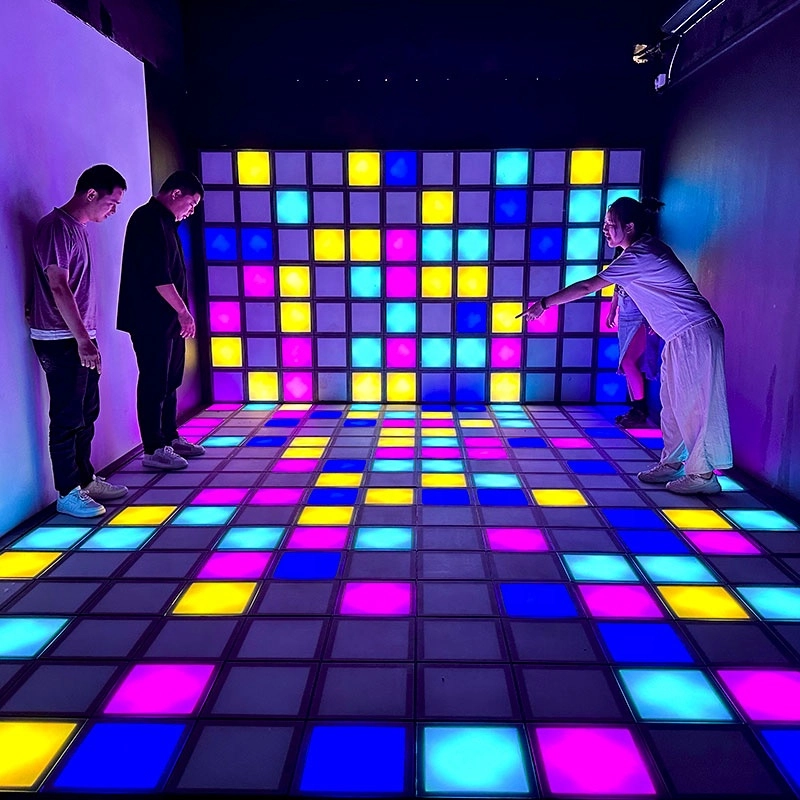
Hottest activated LED dance grid tiles floor touch games
Super Grid is an immersive sports game that combines sports and technology. It integrates interactive LED lights and sensors through innovative software design, creating a fun gaming experience.

Top Indoor Tennis Racketball Training Simulator Dual Player Games
Interactive somatosensory fitness game
Combine traditional tennis sports with advanced 3D digital technology to bring customers an immersive tennis training experience
COMBINE TRADITIONAL TENNIS SPORTS WITH ADVANCED 3D DIGITAL TECHNOLOGY TO BRING CUSTOMERS AN IMMERSIVE TENNIS TRAINING EXPERIENCE INDOOR AND TENNIS EXPERIENCE HALL
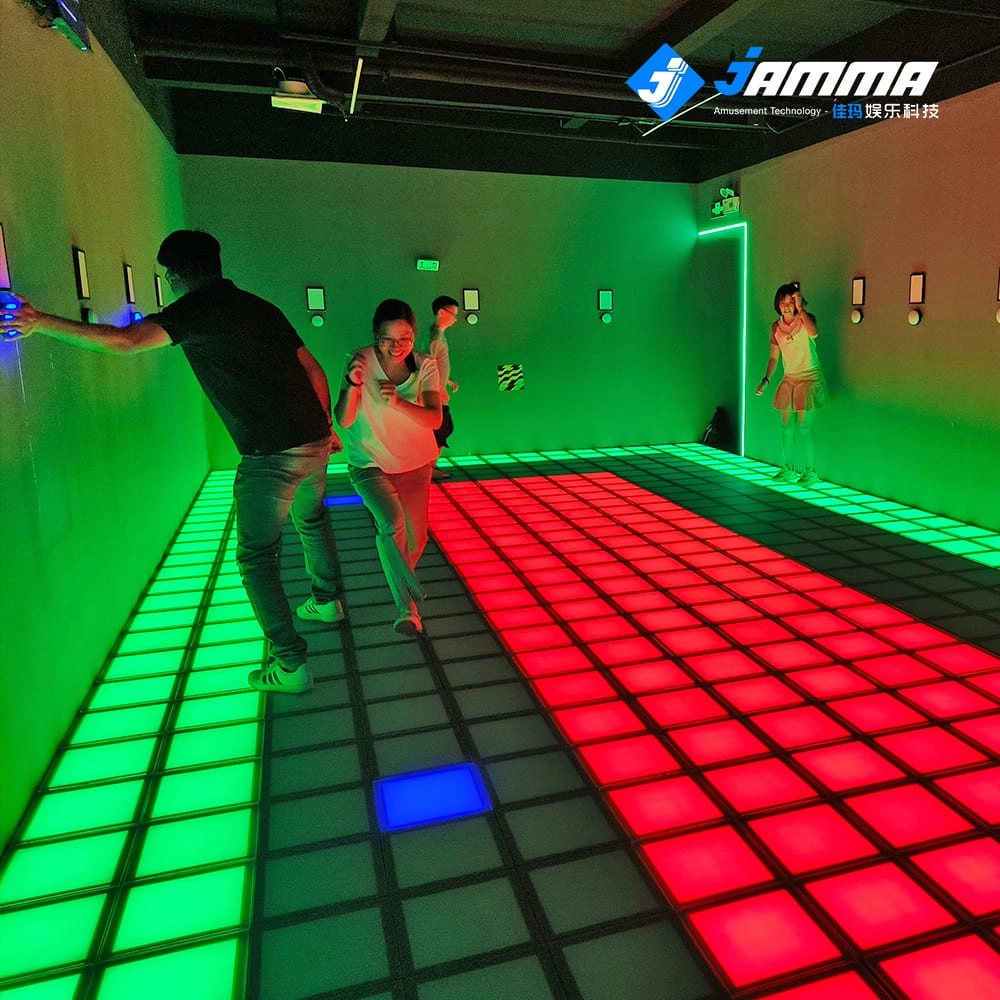
Super Grid Interactive LED Floor Activate Game Team Play
Super Grid is an immersive sports game that combines sports and technology. It integrates interactive LED lights and sensors through innovative software design, creating a fun gaming experience.

Immersive 5D/7D/9D cinema dynamic visual experience room
Compared with other types of theaters, 5D/7D/9D cinema have high technical content, prominent themes, and have a strong impact on the characteristics of the picture. With the increasing demand in the entertainment market and the continuous development of video entertainment technology, in the past, audiences would experience vibration, drop, rain, scratches and other effects in some 4D theaters, but now with 5D theaters, audiences can experience new Unique features, touch and feel effects such asreal smoke, water, snow, bubbles, smell, lightning, leg touch,camera system and more. When the audience is watching amovie, the seats and environmental effects will change into corresponding actions according to the development of the movie,allowing the audience to experience an immersive viewing experience.
