

Projection Football Simulator vs Automatic Ball Return System: Which Is Better for a Commercial Venue?
A projection football simulator uses cameras or sensors to track a real ball and convert each kick into digital gameplay. An automatic ball return soccer simulator adds a mechanical system that collects, returns, or relaunches balls between shots.
- What Is the Difference Between the Two Systems?
- How Does a Projection Football Simulator Work?
- How Does Automatic Ball Return Affect Operation?
- Projection Tracking vs Automatic Ball Return
- Does Automatic Ball Return Always Increase Throughput?
- Which System Fits Your Venue?
- Family Entertainment Centers
- Sports Bars and Competitive Social Venues
- Hotels and Resorts
- Football Academies and Training Centers
- Multi-Sport Entertainment Centers
- Why Work With a Manufacturer and Solution Provider?
- FAQ
What Is the Difference Between the Two Systems?
Both systems allow players to kick a real football toward a screen, target, or goal area. The main difference is what happens after the player takes the shot.
A projection tracking system focuses on detecting the ball. High-speed cameras, infrared sensors, radar, or other tracking devices measure information such as ball speed, direction, angle, and impact position. The software then converts this information into a penalty kick, target challenge, passing game, or simulated match.
An automatic return system adds a physical ball-handling loop. Nets, sloped floors, return channels, conveyors, or launching mechanisms collect the ball and send it back to the player.
This creates two different procurement priorities:
- Projection systems depend heavily on tracking accuracy, calibration, image quality, and software.
- Automatic return systems add mechanical reliability, ball-flow design, blockage handling, and service access.
JAMMA’s commercial Football Simulator uses a high-speed camera to capture ball speed and angle. Buyers should confirm separately whether a project quotation includes any automatic collection, return, or launching equipment.
How Does a Projection Football Simulator Work?
First, the player selects a game or challenge. The system displays a goal, target, goalkeeper, or training scenario on a large screen or projection surface.
The player then kicks a real football toward the screen. The tracking system detects the shot and sends the data to the game software. Finally, the software calculates the result and displays the score, ball path, accuracy, or successful goal.
A complete projection football simulator may include:
- Impact-resistant projection screen
- Commercial projector or display
- High-speed camera or ball-tracking sensor
- Gaming computer
- Football simulation software
- Control interface
- Audio system
- Protective netting
- Ball containment area
- Scoring display
- Optional branding and multilingual interface
Projection-based systems can offer several games without changing the physical equipment. Operators may switch between penalty kicks, target shooting, passing challenges, goalkeeper games, accuracy training, and team competition.
Venues that want several sports in one room can also consider a soccer and golf multi-sport simulator. However, buyers should confirm whether each sport uses the same tracking hardware and whether changing between modes requires physical adjustments.
How Does Automatic Ball Return Affect Operation?

After each kick, the system guides the ball into a collection area. A sloped channel, conveyor, mechanical return, or automatic launcher then moves it back toward the player.
This can improve the flow of repetitive shooting games, particularly when:
-
One player takes several shots in each round
-
The attraction operates continuously during peak periods
-
Staff cannot enter the shooting area after every attempt
-
The venue sells short, high-turnover sessions
-
The operator wants a consistent ball starting position
However, automation creates additional questions. Buyers should ask how the system handles balls that stop outside the return channel, whether different ball sizes can be used, how staff clear a blockage, and how long mechanical parts can operate continuously.
The return mechanism should also have protected moving parts, an accessible maintenance area, an emergency stop, and a clear manual recovery procedure.
Projection Tracking vs Automatic Ball Return
| Buyer Consideration | Projection Tracking System | Automatic Ball Return System |
|---|---|---|
| Primary technology | Cameras, sensors and game software | Ball tracking plus mechanical ball handling |
| Ball collection | Usually manual or based on room design | Automated when the ball enters the return path |
| Space requirement | Can support relatively compact configurations | Often needs additional length or service space |
| Main maintenance | Camera alignment, calibration, screen and projector | Return channel, conveyor, launcher and moving parts |
| Content flexibility | Strong; software can support multiple game modes | Depends on software and launcher configuration |
| Staffing impact | Staff may occasionally retrieve balls | Can reduce routine retrieval |
| Main failure risk | Tracking errors or calibration changes | Tracking errors plus mechanical blockage |
| Best commercial use | FECs, malls, training centers and multi-sport rooms | High-volume football venues and repetitive shooting attractions |
The correct choice depends on the business model. A compact FEC may value software variety and a smaller footprint. A dedicated football venue may value continuous shooting and reduced ball collection.
Buyers can use JAMMA’s multi-sport simulator buying guide to compare additional factors such as tracking technology, software updates, warranties, network requirements, and spare parts.
Does Automatic Ball Return Always Increase Throughput?
No. Automatic return can shorten the interval between shots, but the complete customer cycle determines throughput.
Operators should measure:
- Player briefing time
- Payment and registration time
- Game selection time
- Number of shots per round
- Time between shots
- Total game duration
- Player changeover time
- Equipment reset time
- Ball retrieval or blockage time
- Cleaning and inspection time
- Percentage of time the system remains available
A simple planning formula is:
Hourly player capacity = completed sessions per hour × players per session × realistic utilization rate
For example, a five-minute game does not automatically provide 12 sessions per hour. The venue must also allow time for players to leave, the next group to enter, game selection, ball positioning, and occasional delays.
Furthermore, a faster return system may not improve revenue if customers already spend most of the session selecting games, watching instructions, or waiting for other players.
Therefore, buyers should request a live demonstration of the full operating cycle. A short promotional video showing several successful kicks does not prove sustained commercial throughput.
Which System Fits Your Venue?
Family Entertainment Centers
FECs usually benefit from simple rules, varied games, and moderate session lengths. A projection football simulator can serve children, teenagers, families, and parties without requiring a dedicated football facility.
Sports Bars and Competitive Social Venues
Sports bars need short games, visible scoring, group competition, and strong spectator appeal. Automatic return may be useful when customers take repeated shots, but the venue must also plan seating, sound, ball containment, and safe circulation.
Hotels and Resorts
Hotels often value easy operation and broad guest appeal. Operators should prioritize clear instructions, multilingual software, quiet mechanical operation, and reliable remote support.
Football Academies and Training Centers
Training facilities may care more about tracking accuracy, repeatable ball positions, drill configuration, and performance records than visual effects. They should ask which measurements the system actually records and whether the data is suitable for entertainment or structured training.
Multi-Sport Entertainment Centers
A multi-sport venue may prefer a shared projection room that supports football, golf, baseball, and other games. Buyers should compare changeover time and hardware compatibility before assuming that every sport works equally well.
JAMMA’s guide to commercial indoor sport and entertainment simulator systems provides additional planning considerations for mixed-sport venues.
Why Work With a Manufacturer and Solution Provider?
A football simulator requires more than a projector and sensor. The screen, tracking area, room dimensions, protective structure, software, lighting, audio, ball containment, and player flow must work together.
As an amusement equipment manufacturer and project solution provider, JAMMA can support:
- Equipment selection
- Room and safety-zone planning
- Football simulator configuration
- Projection and tracking setup
- Protective structure and netting design
- Software and branded interface options
- Installation drawings
- Calibration guidance
- Staff training
- Spare parts and after-sales support
- Integration with wider sports entertainment projects
Operators planning several attractions can review JAMMA’s turnkey amusement venue solutions before confirming the final product mix.
FAQ
Is an automatic ball return soccer simulator better than a projection simulator?
Not in every venue. Automatic return can reduce ball collection time, while a projection simulator may offer a smaller footprint and more flexible game content. The best system depends on capacity, room size, staffing, maintenance, and target customers.
How much space does a commercial football simulator need?
The required space depends on shooting distance, screen size, tracking technology, ball containment, and whether the system includes a return channel or launcher. Buyers should provide a measured floor plan before requesting a final quotation.
Can a football simulator operate without staff?
Some functions can be automated, but staff may still need to brief players, inspect the play area, retrieve misplaced balls, handle technical problems, and monitor safe use. Buyers should test the complete operating workflow before planning unattended operation.
Commercial Interactive Drawing Walls: What Should a Complete System Include?
How to Choose the Best Interactive Slide Projection System for Your Indoor Playground
Commercial Multi-Sport Simulator Packages: What to Buy for Hourly Bookings
Commercial Laser Tag Equipment: Vests or Headbands for Your Venue?
Tennis Simulator vs. Ball Machine: Which Should Your Indoor Venue Buy?
Standard and other
Do you offer installation services?
Our professional implementation team can provide equipment installation and debugging services to ensure smooth operation. Our installation services is chargeable and you can contact us in to inquire about the service fees.
Do you offer a customized service?
We can provide logo customization service for all of our products. For certain products, we can also support customization of sizes and game content. If you have any product customization requirements, please contact us and we will confirm the details with you.
How long is the warranty period?
Our products have a one-year warranty period. During the warranty period, if there are any issues with the product that are not caused by human error, we can replace the parts for you free of charge. If the problems are caused by improper use, you will need to purchase the parts and bear the shipping costs yourself.
Product details
How many players can play soccer at the same time?
Up to 4 players can play at the same time, you need to add more soccer balls.
What is the difference between 5D and 3D?
The visual of 5D cinema is the same as that of 3D, compared to 3D, it adds motion simulation and special effects, which are not available in 3D.
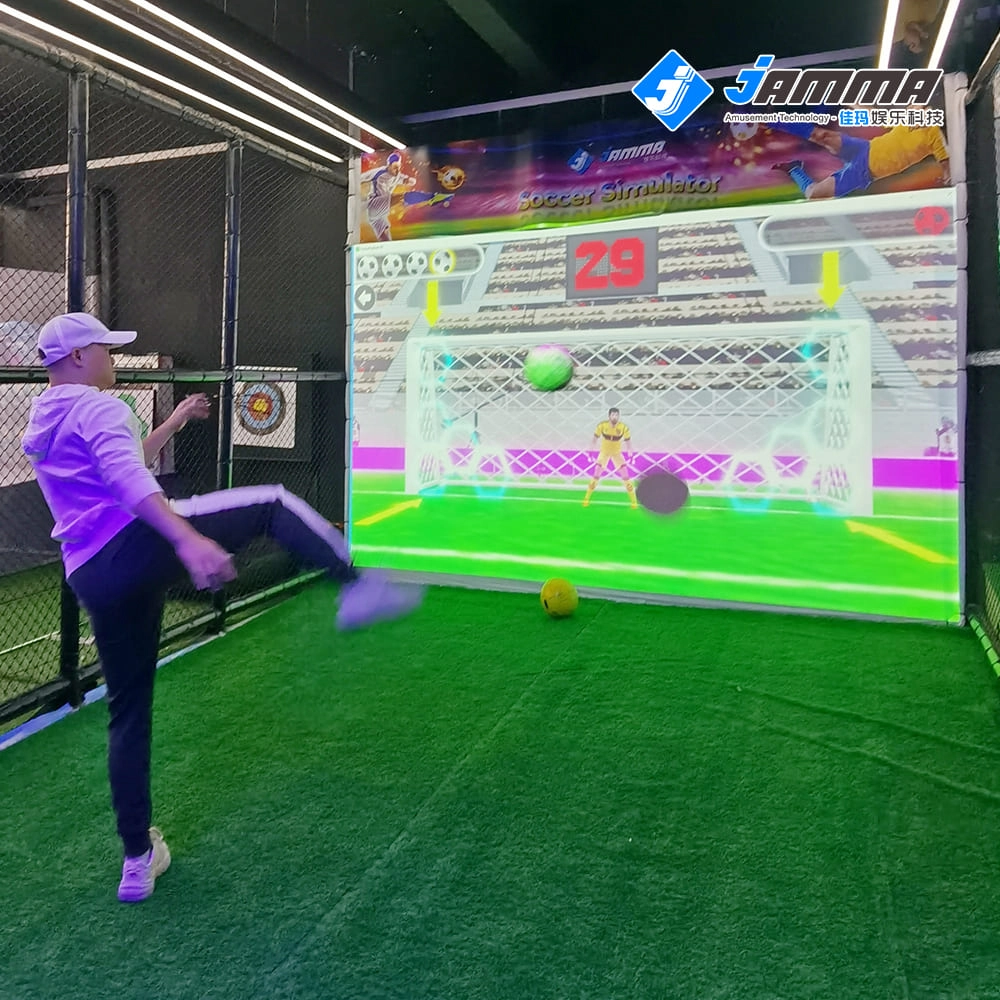
Football Simulator Interactive Projection Penalty Shootout Game
Based on basic soccer rules, a soccer simulator takes you back to the real and exciting competitive scene through augmented reality technology.
Choose your favorite game and start kicking. The high-speed camera can accurately capture the ball speed and angle to simulate a real soccer experience.
Even though the simulator is very simple to use, it is very enjoyable to play every time.
Get in Touch With JAMMA
Would you like to learn more about indoor & outdoor playground equipment?
We would be happy to help you and find the best solution for your needs.
