

How Does a Commercial Hide Sensor Challenge Room Work? Equipment, Game Modes, Layout, and Manufacturer Guide
A commercial Hide sensor challenge room asks players to complete illuminated tasks while avoiding detection. Unlike a traditional arcade machine, the game requires players to move, communicate, react, and make decisions together.
- What Is a Commercial Hide Sensor Challenge Room?
- A team game that combines movement, strategy, and detection
- How Does the Hide Sensor Game Work?
- Players complete light-based missions without triggering detection
- Possible game modes
- What Equipment Does a Hide Challenge Room Need?
- How Should Operators Plan the Room Layout?
- Good planning improves detection accuracy and player safety
- Why Can Hide Add Value to an Active Game Venue?
- Strategy-based gameplay balances high-energy attractions
- What Should a Hide Game Manufacturer and Solution Provider Supply?
- A complete project requires more than individual components
- FAQ
As a result, Hide can add a different type of gameplay to an active game room, family entertainment center, competitive socializing venue, indoor sports park, or technology-based escape room.
What Is a Commercial Hide Sensor Challenge Room?
A team game that combines movement, strategy, and detection
A Hide sensor challenge room is an interactive physical game in which players work together to switch off illuminated targets while avoiding detection by the room’s sensor system.
Players cannot simply run toward every target. Instead, they must observe the room, choose the right moment to move, hide when necessary, and cooperate with their teammates.
Therefore, the game tests several abilities at the same time:
- Reaction speed
- Spatial awareness
- Team communication
- Timing and movement control
- Strategic decision-making
JAMMA has already included Hide in international active gaming projects such as the Let’s Move active gaming arena in the United States and the Dugout X project in India.
How Does the Hide Sensor Game Work?
Players complete light-based missions without triggering detection
First, the system starts a timed game round. Illuminated targets or buttons then appear around the challenge area. Players must move through the room and deactivate the correct lights.
Meanwhile, the sensor system monitors the designated detection area. When the game activates the detection phase, players must stop, hide, or move into a safe position. If the system detects a player at the wrong moment, it can deduct points, record a mistake, or restart part of the mission.
Finally, the game software calculates the team’s result according to factors such as:
- Targets completed
- Completion time
- Detection mistakes
- Remaining lives
- Selected difficulty level
Because the game combines simple rules with changing conditions, operators can offer short sessions while still encouraging customers to play again.
Possible game modes
A customized system can support several types of gameplay:
- Team Mission: Players cooperate to complete every target.
- Time Attack: The team clears the room before time expires.
- Limited Lives: Each detection removes one life.
- Progressive Levels: Sensor timing and target sequences become more difficult.
- Team Competition: Two groups compare completion times and scores.
- Memory Challenge: Players remember and activate targets in the correct order.
These modes make Hide suitable for families, teenagers, parties, school groups, and corporate events.
What Equipment Does a Hide Challenge Room Need?
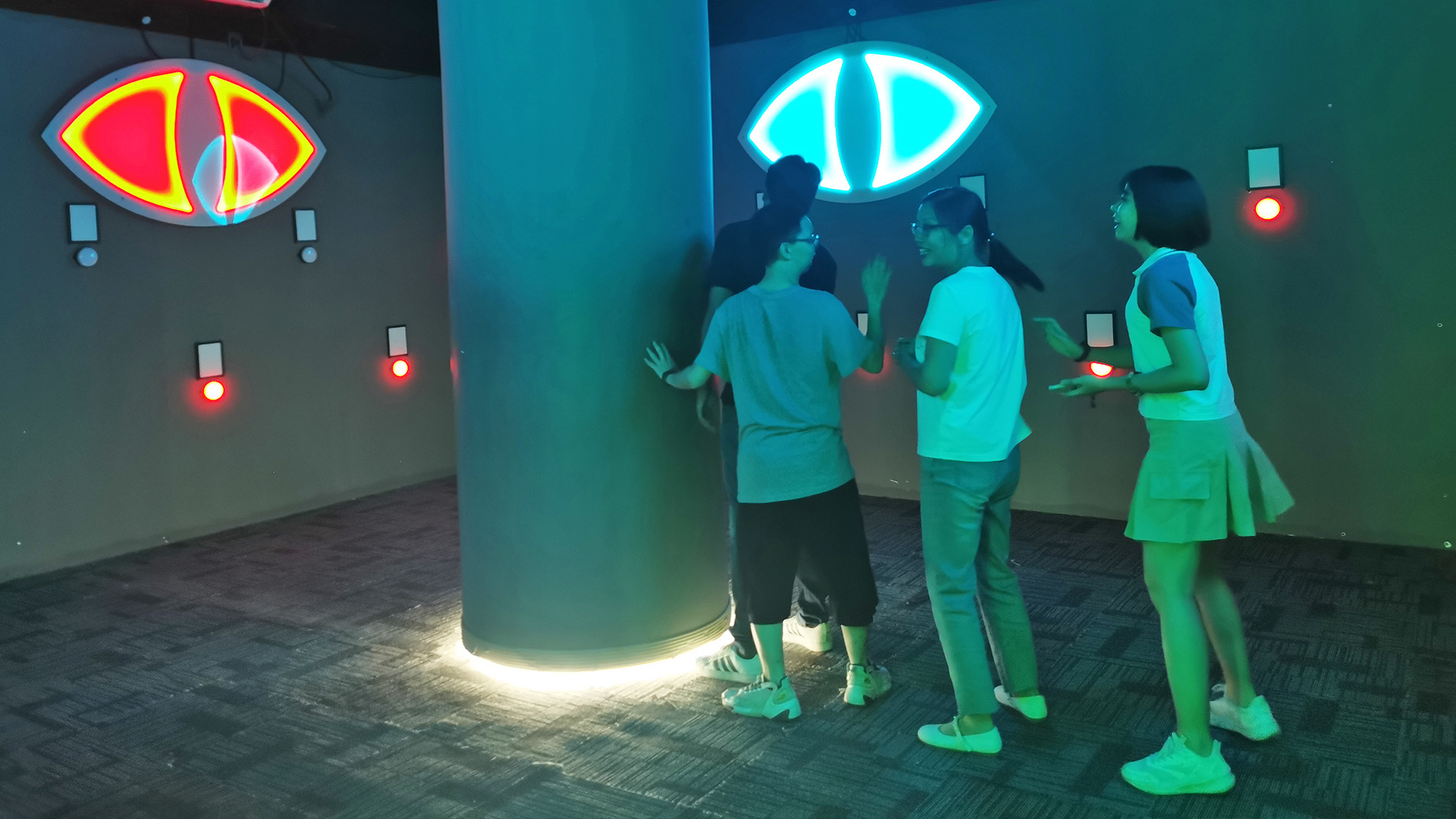
A commercial Hide room needs more than sensors. The operator must connect the physical equipment, control hardware, game software, lighting, sound, and scoring system.
A typical equipment package may include:
-
Illuminated wall targets or interactive buttons
-
Detection sensors or cameras
-
Game control cabinet
-
Central control computer
-
Game and scoring software
-
Start, pause, and reset controls
-
Countdown and score display
-
Speakers and sound effects
-
Room lighting and visual effects
-
Network and power connections
-
Optional RFID player identification
-
Optional central leaderboard
Operators can also combine Hide with a reaction wall game, LED floor room, laser maze, Hoops, Arena, or Grid challenge. This variety helps a venue create a complete competitive socializing experience.
How Should Operators Plan the Room Layout?
Good planning improves detection accuracy and player safety
The layout must give players enough room to move, change direction, reach targets, and use hiding positions safely. At the same time, the detection system needs clear and carefully planned coverage.
For example, JAMMA’s Let’s Move project uses approximately 40 square meters for its Hide room. However, this figure should serve only as a project reference. The final size depends on the number of players, room shape, selected game rules, sensor positions, and local safety requirements.
Before production, the supplier should confirm:
- Usable room dimensions
- Entrance and emergency exit positions
- Sensor coverage
- Target installation points
- Safe player circulation
- Cable routing
- Control cabinet location
- Staff observation access
- Ventilation and lighting conditions
In addition, operators should avoid sharp corners, loose cables, slippery floors, and unnecessary obstacles. They should also test and calibrate the sensors before opening the attraction.
For more preparation details, buyers can follow JAMMA’s active game room installation and after-sales checklist.
Why Can Hide Add Value to an Active Game Venue?
Strategy-based gameplay balances high-energy attractions
Many active game venues already include running, jumping, throwing, or climbing challenges. However, a strong venue should not make every room test the same skill.
Hide introduces slower, more strategic moments between bursts of movement. Consequently, it complements high-energy attractions such as Grid, Hoops, Arena, Climb, and Laser Maze.
The game also offers several commercial advantages:
- Players understand the basic objective quickly.
- Team-based rules encourage social interaction.
- Adjustable difficulty supports different age groups.
- Timed missions help operators manage throughput.
- Automated scores encourage replay.
- Spectators can easily follow the action.
- Different game modes keep the room fresh.
Furthermore, operators can connect Hide to RFID wristbands and a central leaderboard. Players can then save their results, compare rankings, and continue their journey through other challenge rooms.
Operators planning a larger venue can review JAMMA’s global active game project cases for different room combinations and center sizes.
What Should a Hide Game Manufacturer and Solution Provider Supply?
A complete project requires more than individual components
A supplier may provide sensors and buttons. However, a manufacturer should also control equipment quality and configuration. More importantly, a solution provider should make the room, hardware, software, installation, and operation work together.
A qualified Hide challenge room partner should provide:
- Commercial-grade interactive equipment
- Customized room layout
- Sensor position planning
- Game software and scoring rules
- Difficulty and game mode configuration
- Electrical and network drawings
- Installation and calibration guidance
- Branding and language customization
- Staff operation training
- Spare parts and technical support
- Future software or game updates
JAMMA works as an active game equipment manufacturer and turnkey solution provider. JAMMA can support equipment selection, room planning, manufacturing, software configuration, system integration, installation guidance, training, and after-sales service.
Therefore, buyers do not need to combine unrelated equipment from several suppliers. Instead, they can develop Hide as part of a complete active gaming venue.
Read the JAMMA Activate Game Supplier Guide to learn how to select equipment and plan a complete commercial challenge center.
FAQ
What is a Hide sensor challenge room?
A Hide sensor challenge room is an interactive team attraction where players complete illuminated targets while avoiding detection. The system records time, mistakes, completed tasks, and scores through sensors and game software.
How much space does a commercial Hide game need?
The required space depends on the room shape, player capacity, sensor coverage, and game design. One JAMMA project uses approximately 40 square meters for Hide, but the manufacturer should customize the final layout for each venue.
Can a Hide challenge room connect to RFID scoring and leaderboards?
Yes. A supplier can integrate the room with RFID wristbands, player accounts, scoring software, and a central leaderboard. This connection allows players to save results and compare their performance across multiple active game rooms.

Can You Add an LED Reaction Wall Without Building a Separate Game Room?
Laser Maze vs. Laser Tag: Which Attraction Should an Escape Room Operator Buy?
Commercial Pixel Game Room Equipment: A Buyer’s Guide for FECs and Escape Rooms
What Equipment Should an Indoor Park Franchise Standardize Across Every Location?
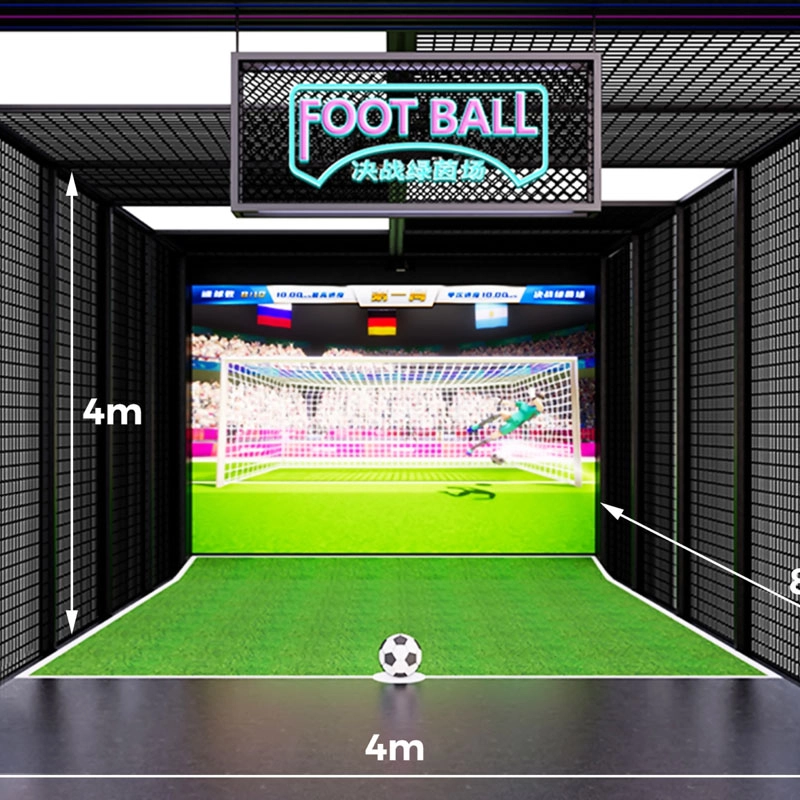
Projection Football Simulator vs Automatic Ball Return System: Which Is Better for a Commercial Venue?
Product details
What are the special effects in a 5D cinema?
JAMMA 5D cinema has special effects such as water spray, smoke, bubbles, snow, lightning and so on, which allows it to provide a realistic and immersive experience.
Does the soccer simulator configuration include the curtain?
Yes, a 4-meter-wide, 3-meter-high projection curtain is included.
Standard and other
How long is the warranty period?
Our products have a one-year warranty period. During the warranty period, if there are any issues with the product that are not caused by human error, we can replace the parts for you free of charge. If the problems are caused by improper use, you will need to purchase the parts and bear the shipping costs yourself.
Are you an amusement park equipment manufacturer?
Yes. We have our own production factory, which is located in Guangzhou, China, covering an area of over 2,000 square meters. With our professional production team, we are able to ensure high quality and on-time delivery of our products. All products have undergone rigorous testing and quality inspection. You are welcome to visit our factory.
What is the delivery time?
Usually the production period of our products is 20 to 25 days, it will be a little different according to the quantity of products you order. All products need to go through our strict quality inspection before shipment. After they are tested, we will ship them to you at the first time. For products in stock, we usually ship within 3 days.
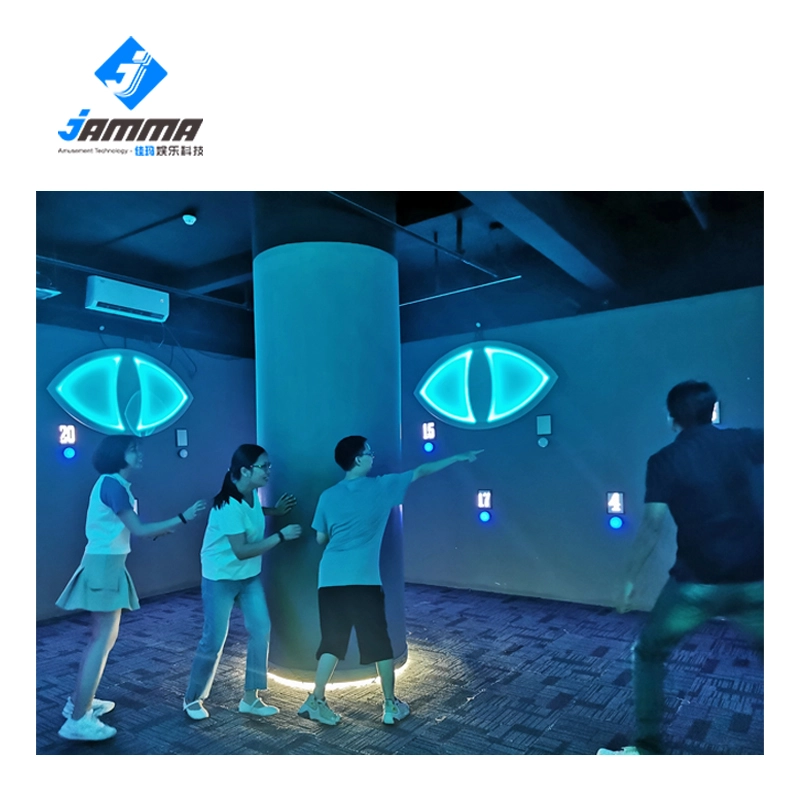
Activate Team Interactive Escape Room Challenge Game - Devil's Eye
Inspired by the globally popular TV series "Squid Game," Hide is a thrilling teamwork challenge game that recreates the heart-wrenching plot of the famous series to give players the ultimate thrilling experience. Players need to co-operate with friends to complete tasks and avoid sensor detection. Interactive technology with real-time reactions ensures an adrenaline-filled adventure.
This game has received enthusiastic market feedback since its launch and is becoming a fast-growing and highly profitable project with a steady stream of customers at various venues.
Get in Touch With JAMMA
Would you like to learn more about indoor & outdoor playground equipment?
We would be happy to help you and find the best solution for your needs.
